Advertisements
Advertisements
प्रश्न
A train starting from rest picks up a speed of 20 ms−1 in 200 s. It continues to move at the same rate for the next 500 s and is then brought to rest in another 100 s.
- Plot a speed-time graph.
- From graph calculate
(a) uniform rate of acceleration
(b) uniform rate of retardation
(c) total distance covered before stopping
(d) average speed.
Advertisements
उत्तर
(i)

(ii)
(a) Uniform rate of acceleration = Slope of v.t. graph from O to A.
= `"AE"/"OE"=20/200` = 0.1 ms−2
(b) Uniform rate of retardation = Slope of v.t. graph from BC
= `"BD"/"CD"=20/100` = 0.2 ms−2
(c) Total distance covered before stopping
= ar(ΔOAE) + ar(ΔABDE) + ar(ΔBCD)
= `1/2xx"OE"xx"AE"+"AE"xx"ED" + 1/2xx"BD"xx"DC"`
= `1/2xx200xx20+20xx500+1/2xx20xx100`
= 2000 + 10000 + 1000
= 13000 m
= 13 km
(d) Average speed = `"Total distance covered"/"Total time taken"=13000/800`
= `130/8`
= 16.25 ms−1
APPEARS IN
संबंधित प्रश्न
What can you say about the motion of a body if its speed-time graph is a straight line parallel to the time axis ?
Fill in the following blank with suitable word :
In a speed-time graph, the area enclosed by the speed-time curve and the time axis gives the…………….. by the body.
Draw a displacement-time graph for a boy going to school with uniform velocity.
What does the slope of velocity-time graph represent?
Multiple choice Question. Select the correct option.
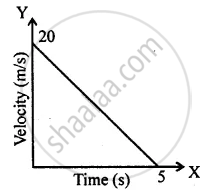
The distance covered in the adjoining velocity-time graph is :
Represent the location of an object described as at 15 m, 45o west of north, on a graph paper.
How will you use a speed-time graph to find whether the acceleration of the body is uniform or not?
Interpret the following graph: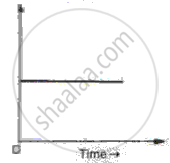
An object is moving in a positive direction with positive acceleration. The velocity-time graph with constant acceleration which represents the above situation is:
The velocity-displacement graph describing the motion of a bicycle is shown in the figure.

The acceleration-displacement graph of the bicycle's motion is best described by:
