Advertisements
Advertisements
Question
A train starting from rest picks up a speed of 20 ms−1 in 200 s. It continues to move at the same rate for the next 500 s and is then brought to rest in another 100 s.
- Plot a speed-time graph.
- From graph calculate
(a) uniform rate of acceleration
(b) uniform rate of retardation
(c) total distance covered before stopping
(d) average speed.
Advertisements
Solution
(i)

(ii)
(a) Uniform rate of acceleration = Slope of v.t. graph from O to A.
= `"AE"/"OE"=20/200` = 0.1 ms−2
(b) Uniform rate of retardation = Slope of v.t. graph from BC
= `"BD"/"CD"=20/100` = 0.2 ms−2
(c) Total distance covered before stopping
= ar(ΔOAE) + ar(ΔABDE) + ar(ΔBCD)
= `1/2xx"OE"xx"AE"+"AE"xx"ED" + 1/2xx"BD"xx"DC"`
= `1/2xx200xx20+20xx500+1/2xx20xx100`
= 2000 + 10000 + 1000
= 13000 m
= 13 km
(d) Average speed = `"Total distance covered"/"Total time taken"=13000/800`
= `130/8`
= 16.25 ms−1
APPEARS IN
RELATED QUESTIONS
Show by using the graphical method that: `s=ut+1/2at^2` where the symbols have their usual meanings.
Derive the following equation of motion by the graphical method : v2 = u2 + 2as, where the symbols have their usual meanings.
A car of mass 1000 kg is moving with a velocity of 10 m s−1. If the velocity-time graph for this car is a horizontal line parallel to the time axis, then the velocity of car at the end of 25 s will be :
Multiple choice Question. Select the correct option.
A graph is a straight line parallel to the time axis in a distance-time graph. From the graph, it implies:
Draw the speed-time graph of a body starting from some point P, gradually picking up speed, then running at a uniform speed and finally slowing down to stop at some point Q.
Interpret the following graph: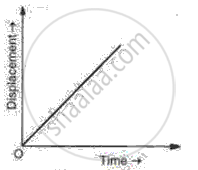
Derive the equation
S = ut+ `1/2` at2
Using a speed- time graph
Figure shows the distance-time graph of three students A, B and C. On the basis of the graph, answer the following :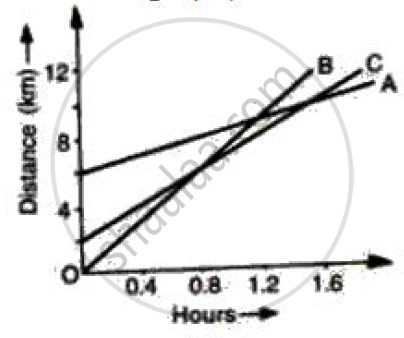
Will the three ever meet at any point on the road?
The area under the v-t graph represents a physical quantity that has the unit.
An object is moving in a positive direction with positive acceleration. The velocity-time graph with constant acceleration which represents the above situation is:
