Advertisements
Advertisements
Question
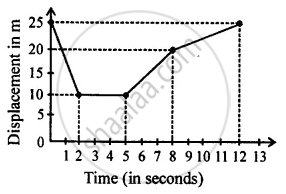
From the displacement – time graph shown given below calculate :
- Velocity between 0 – 2 s.
- Velocity between 8 s – 12 s.
- Average velocity between 5 s – 12 s.
Advertisements
Solution
1. Velocity between 0 – 2 s = `(-(25-10))/2` .......[negative sign because slope is negative]
= `-15/2`
= −7.5 ms−1
2. Velocity between 8 s – 12 s = `(25-20)/(12-8)=5/4`
= 1.25 ms−1
3. Average velocity between 5 s – 12 s
= `"Total displacement from 5 s to 12 s"/"Time"`
= `(25-10)/(12-5)`
= `15/7`
= 2.1 ms−1
APPEARS IN
RELATED QUESTIONS
What is the difference between distance travelled by a body and its displacement ? Explain with the
help of a diagram.
When is the magnitude of displacement equal to the distance?
A train takes 3 h to travel from Agra to Delhi with a uniform speed of 65 km h-1. Find the distance between the two cities.
State how the velocity-time graph can be used to find The distance travelled by the body in a given time
Write an expression for the distance S covered in time t by a body which is initially at rest and starts moving with a constant acceleration a.
A body starts with an initial velocity of 10m s-1 and acceleration 5 m s-2. Find the distance covered by it in 5 s.
Write two differences between distance and displacement.
A body is moving along a circular path of radius r. What will be the distance and displacement of the body when it completes:
Half a revolution
Is distance covered during nth second more than the distance covered in n seconds?
Distance travelled by a freely falling body is proportional to ______.
