Advertisements
Advertisements
Question
How can you find the following?
Displacement from velocity – time graph.
Advertisements
Solution
Displacement from velocity – time graph: Displacement covered by a body is equal to the area under velocity – time graph. When an object moves with a uniform velocity, the velocity – time graph is a straight line (PQ) parallel to the time axis.

Take any two points A and B on velocity – time graph.
From A and B, draw two perpendiculars AD and BC on the time axis such that
OD = t1 and OC = t2
Let OP = AD = BC = v = Velocity of the body.
Area under velocity – time graph = Area of rectangle ABCD
= AD × DC = v × (OC − OD) = v (t2 − t1)
= Displacement covered by the body
APPEARS IN
RELATED QUESTIONS
Is displacement a scalar quantity ?
A body is moving along a circular path of radius R. What will be the distance travelled and displacement of the body when it completes half a revolution ?
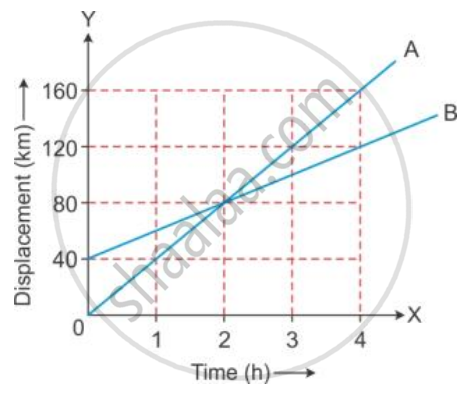
Figure ahead represents the displacement - time sketch of motion of two cars A and B . Find :
(i) the distance by which the car B was initially ahead of car A.
(ii) the velocities of car A and car B.
(iii) the time in which car A catches car B.
(iv) the distance from start when the car A will catch the car B.
A body starts with an initial velocity of 10m s-1 and acceleration 5 m s-2. Find the distance covered by it in 5 s.
A motor car slows down from 72 kmh−1 to 36 kmh−1 over a distance of 25 m. If the brakes are applied with the same force
calculate
- total time in which car comes to rest
- distance travelled by it.
State whether true or false. If false, correct the statement.
Distance covered by a particle never becomes zero but displacement becomes zero.
The SI unit of displacement is ______.
Distance is a ______ quantity.
A man leaves his house at 6.30 a.m. for a morning walk and returns back at 7.30 a.m. after covering 4 km. The Displacement covered by him is ______.
Displacement is the ______ distance covered by a body.
