Advertisements
Advertisements
प्रश्न
How can you find the following?
Displacement from velocity – time graph.
Advertisements
उत्तर
Displacement from velocity – time graph: Displacement covered by a body is equal to the area under velocity – time graph. When an object moves with a uniform velocity, the velocity – time graph is a straight line (PQ) parallel to the time axis.

Take any two points A and B on velocity – time graph.
From A and B, draw two perpendiculars AD and BC on the time axis such that
OD = t1 and OC = t2
Let OP = AD = BC = v = Velocity of the body.
Area under velocity – time graph = Area of rectangle ABCD
= AD × DC = v × (OC − OD) = v (t2 − t1)
= Displacement covered by the body
APPEARS IN
संबंधित प्रश्न
State whether distance is a scalar or a vector quantity.
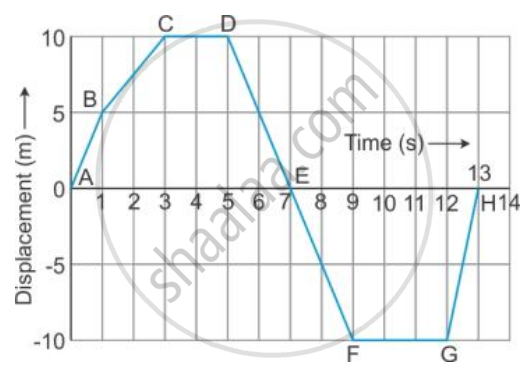
From the displacement-time graph of a cyclist given below in the Figure, find The displacement from the initial position at the end of 10 s,
Define Displacement.
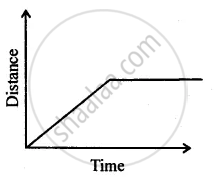
Can you suggest the kind of motion of a body from the following distance – time graph?
A motorbike running at 90 kmh−1, is slowed down to 54 kmh−1 by the application of brakes, over a distance of 40 m. If the brakes are applied with the same force, calculate
- total time in which bike comes to rest
- total distance travelled by bike.
Write the SI units for measurement of distance and displacement.
The shortest distance between two places is ______.
Fill in the boxes.
| S.No | First Move | Seconde Move | Distance (m) | Displacement |
| 1. | Move 4 metres east | Move 2 metres west | 6 | 2 m east |
| 2. | Move 4 metres north | Move 2 metres south | ||
| 3. | Move 2 metres east | Move 4 metres west | ||
| 4. | Move 5 metres east | Move 5 metres west | ||
| 5. | Move 5 metres south | Move 2 metres north | ||
| 6. | Move 10 metres west | Move 3 metres east |
The rate of change of displacement ______.
A man leaves his house at 6.30 a.m. for a morning walk and returns back at 7.30 a.m. after covering 4 km. The Displacement covered by him is ______.
