Advertisements
Advertisements
प्रश्न
How can you find the following?
Displacement from velocity – time graph.
Advertisements
उत्तर
Displacement from velocity – time graph: Displacement covered by a body is equal to the area under velocity – time graph. When an object moves with a uniform velocity, the velocity – time graph is a straight line (PQ) parallel to the time axis.

Take any two points A and B on velocity – time graph.
From A and B, draw two perpendiculars AD and BC on the time axis such that
OD = t1 and OC = t2
Let OP = AD = BC = v = Velocity of the body.
Area under velocity – time graph = Area of rectangle ABCD
= AD × DC = v × (OC − OD) = v (t2 − t1)
= Displacement covered by the body
APPEARS IN
संबंधित प्रश्न
A farmer moves along the boundary of a square field of side 10 m in 40 s. What will be the magnitude of displacement of the farmer at the end of 2 minutes 20 seconds?
The minimum distance between the start and finish points of the motion of an object is called the ______ of the object.
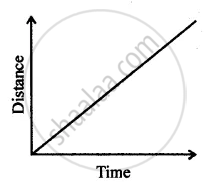
Can you suggest the kind of motion of a body from the following distance – time graph?
Write the SI units for measurement of distance and displacement.
A body is moving along a circular path of radius r. What will be the distance and displacement of the body when it completes:
Two full revolutions
Is distance covered during nth second more than the distance covered in n seconds?
A 50 m long train passes over a bridge at a speed of 30 km/h. If it takes 36 seconds to cross the bridge, calculate the length of the bridge.
Match the following.
| 1. | Displacement | Knot |
| 2. | Light travelling through vacuum | Geometric centre |
| 3. | Speed of ship | Metre |
| 4. | Centre of gravity of geometrical shaped objects | Larger base area |
| 5. | Stability | Uniform velocity |
Fill in the boxes.
| S.No | First Move | Seconde Move | Distance (m) | Displacement |
| 1. | Move 4 metres east | Move 2 metres west | 6 | 2 m east |
| 2. | Move 4 metres north | Move 2 metres south | ||
| 3. | Move 2 metres east | Move 4 metres west | ||
| 4. | Move 5 metres east | Move 5 metres west | ||
| 5. | Move 5 metres south | Move 2 metres north | ||
| 6. | Move 10 metres west | Move 3 metres east |
Four cars A, B, C, and D are moving on a levelled road. Their distance versus time graphs are shown in Fig. 8.2. Choose the correct statement.

