Advertisements
Advertisements
प्रश्न
How can you find the following?
Acceleration from velocity – time graph.
Advertisements
उत्तर
Acceleration from velocity – time graph: Velocity – time graph for uniform motion in a straight line (OP) inclined to the time axis.

Take any two points A and B on this graph. From A and B draw perpendicular on the time axis as well as velocity axis in such a way that
OA1 = t1, OB1 = t2, OA2 = v1 and OB2 = v2
Slope of v – t graph = `"BC"/"AC"`
= `("v"_2-"v"_1)/("t"_2-"t"_1)=(Δ"v")/(Δ"t")` = Acceleration of the body
So, by knowing the slope of velocity – time graph for uniform motion, we can find the acceleration of the body.
APPEARS IN
संबंधित प्रश्न
A bus running at a speed of 18 km/h is stopped in 2.5 seconds by applying brakes. Calculate the retardation produced.
Explain the meaning of the following equation of motion :v = u + at, where symbols have their usual meanings.
If a stone and a pencil are dropped simultaneously in vacuum from the top of a tower, then which of the two will reach the ground first? Give reason.
State how the velocity-time graph can be used to find
The acceleration of a body
Can you suggest a real-life example about the motion of a body from the following velocity – time graph?
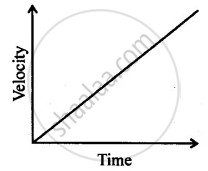
Can you suggest a real-life example about the motion of a body from the following velocity – time graph?
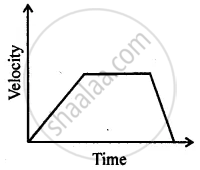
Can you suggest a real-life example about the motion of a body from the following velocity – time graph?
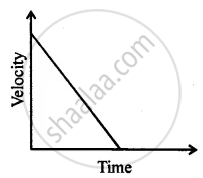
A stone thrown vertically upwards takes 3 s to attain maximum height. Calculate
- initial velocity of the stone
- maximum height attained by the stone. (Take g = 9.8 ms−2)
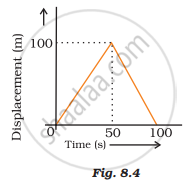
A girl walks along a straight path to drop a letter in the letterbox and comes back to her initial position. Her displacement–time graph is shown in Fig.8.4. Plot a velocity-time graph for the same.
Draw a velocity versus time graph of a stone thrown vertically upwards and then coming downwards after attaining the maximum height.
