Advertisements
Advertisements
प्रश्न
If a stone and a pencil are dropped simultaneously in vacuum from the top of a tower, then which of the two will reach the ground first? Give reason.
Advertisements
उत्तर
In vacuum, both will reach the ground simultaneously because acceleration due to gravity is same (=g) on both objects.
APPEARS IN
संबंधित प्रश्न
A bus decreases its speed from 80 km h−1 to 60 km h−1 in 5 s. Find the acceleration of the bus.
Which of the two can be zero under certain conditions : average speed of a moving body or average velocity of a moving body ?
Give one example of a situation in which a body has a certain average speed but its average velocity is zero.
Fill in the following blank with a suitable word:
Acceleration is the rate of change of ______ It is measured in ______
Define velocity. What is the SI unit of velocity ?
Fill in the following blank with suitable word :
If a body moves with uniform velocity, its acceleration is ..............
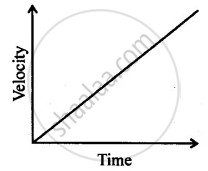
Can you suggest a real-life example about the motion of a body from the following velocity – time graph?
A packet is dropped from a stationary helicopter, hovering at a height ‘h’ from ground level, reaches the ground in 12s. Calculate
- the value of h
- final velocity of packet on reaching the ground. (Take g = 9.8 ms−2)
Draw a velocity versus time graph of a stone thrown vertically upwards and then coming downwards after attaining the maximum height.
An electron moving with a velocity of 5 × 10⁴ ms−1 enters into a uniform electric field and acquires a uniform acceleration of 104 ms–2 in the direction of its initial motion.
(i) Calculate the time in which the electron would acquire a velocity double of its initial velocity.
(ii) How much distance the electron would cover at this time?
