Advertisements
Advertisements
प्रश्न
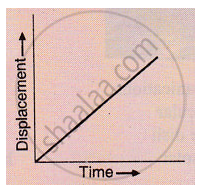
What conclusion can you draw about the velocity of a body from the displacement-time graph shown below :
Advertisements
उत्तर
It represents uniform velocity. In this type of motion, body covers equal distance in equal interval of time in a specific direction.
APPEARS IN
संबंधित प्रश्न
When will you say a body is at non-uniform acceleration?
A motorcycle moving with a speed of 5 m/s is subjected to an acceleration of 0.2 m/s2. Calculate the speed of the motorcycle after 10 seconds, and the distance travelled in this time.
Derive the formula s= `ut+1/2at^2` , where the symbols have usual meanings.
If a stone and a pencil are dropped simultaneously in vacuum from the top of a tower, then which of the two will reach the ground first? Give reason.
Write three equations of uniformly accelerated motion relating the initial velocity (u), final velocity (v), time (t), acceleration (a) and displacement (S).
When is the negative acceleration?
Multiple choice Question. Select the correct option.
A body dropped from the top of a tower reaches the ground in 4s. Height of the tower is
How can you find the following?
Acceleration from velocity – time graph.
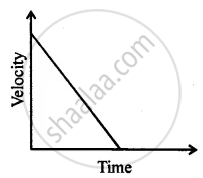
Can you suggest a real-life example about the motion of a body from the following velocity – time graph?
Two stones are thrown vertically upwards simultaneously with their initial velocities u1 and u2 respectively. Prove that the heights reached by them would be in the ratio of `"u"_1^2 : "u"_2^2` (Assume upward acceleration is –g and downward acceleration to be +g)
