Advertisements
Advertisements
प्रश्न
A motorcycle moving with a speed of 5 m/s is subjected to an acceleration of 0.2 m/s2. Calculate the speed of the motorcycle after 10 seconds, and the distance travelled in this time.
Advertisements
उत्तर
We have to find the distance travelled and final velocity of the body. We have the following information given,
Initial velocity, (u) = 5 m/s
Acceleration, (a) = 0.2 m/s2
Time taken, (t) = 10 s
So, we can find the final velocity using the relation,
v = u + at
So, final velocity,
v = 5 + (0.2)(10)
= 7 m/s
We can calculate the distance travelled by using the 2nd equation of motion,
`s = ut + 1/2 at^2`
Put the values in above equation to find the distance travelled by the motorcycle ,
`(s) = 5(10) + 1/2(0.2)(10)^2`
= (50 + 10) m
= 60 m
APPEARS IN
संबंधित प्रश्न
A bus decreases its speed from 80 km h−1 to 60 km h−1 in 5 s. Find the acceleration of the bus.
Name the physical quantity whose SI unit is :
(a) m/s (b) m/s2
Fill in the following blank with suitable word :
A motorcycle has a steady……………. of 3 m/s2. This means that every………………. its…………….. increases by………….
What is meant by the term acceleration ? State the SI unit of acceleration.
A train travelling at 20 m s-1 accelerates at 0.5 m s-2 for 30 s. How far will it travel in this time ?
Derive the formula : v = u + at, where the symbols have usual meanings.
When a car driver travelling at a speed of 10 m/s applies brakes and brings the car to rest in 20 s, then retardation will be :
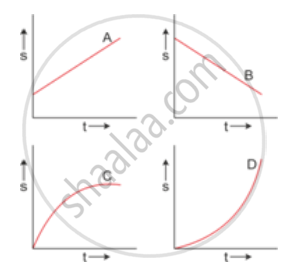
The figure shows the displacement - time graph for four bodies A, B C and D. In each case state what information do you get about the acceleration (zero, positive or negative).
A packet is dropped from a stationary helicopter, hovering at a height ‘h’ from ground level, reaches the ground in 12s. Calculate
- the value of h
- final velocity of packet on reaching the ground. (Take g = 9.8 ms−2)
A stone thrown vertically upwards takes 3 s to attain maximum height. Calculate
- initial velocity of the stone
- maximum height attained by the stone. (Take g = 9.8 ms−2)
