Advertisements
Advertisements
प्रश्न
A body is thrown vertically upward with velocity u, the greatest height h to which it will rise is,
पर्याय
`"u"/"g"`
`"u"^2/(2"g")`
`"u"^2/"g"`
`"u"/(2"g")`
Advertisements
उत्तर
`"u"^2/(2"g")`
At highest point, v = 0
Using v2– u2 = 2as, we get
0 − u2 = 2(−g)h ( ∵ a = −g and s = h)
or h = `"u"^2/(2"g")`
APPEARS IN
संबंधित प्रश्न
A bus decreases its speed from 80 km h−1 to 60 km h−1 in 5 s. Find the acceleration of the bus.
Give one example of a situation in which a body has a certain average speed but its average velocity is zero.
Derive the formula s= `ut+1/2at^2` , where the symbols have usual meanings.
A car is travelling along the road at 8 ms-1. It accelerates at 1 ms-2 for a distance of 18 m. How fast is it then travelling ?
The figure shows the displacement - time graph for four bodies A, B C and D. In each case state what information do you get about the acceleration (zero, positive or negative).
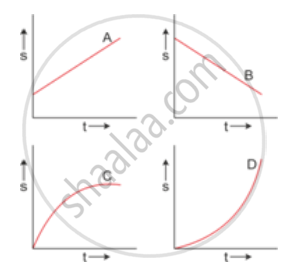
Derive the following equations for uniformly accelerated motion:
(i) v = u + at
(ii) `"S = ut" + 1/2 "at"^2`
(iii) v2 = u2 + 2aS
where the symbols have their usual meanings.
Can you suggest a real-life example about the motion of a body from the following velocity – time graph?
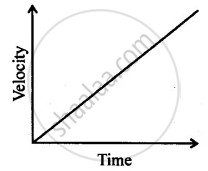
Can you suggest a real-life example about the motion of a body from the following velocity – time graph?
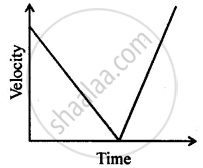
Area under a v – t graph represents a physical quantity which has the unit
When will you say a body is at uniform acceleration?
