Advertisements
Advertisements
प्रश्न
A cheetah starts from, rest, and accelerates at 2 m/s2 for 10 seconds. Calculate :
(a) the final velocity
(b) the distance travelled.
Advertisements
उत्तर
We have to find the distance travelled by the cheetah. We have the following information given,
So, initial velocity, (u) = 0 m/s
Acceleration, (a) = 2 m/s2
Time taken, (t) = 10 s
(a) So, we can find the final velocity using the relation, v = u + at
Final velocity,
v = 0 + (2) (10)
= 20 m/s
(b) We can calculate the distance travelled by cheetah using the 2nd equation of motion,
`s = ut + 1/2 at^2`
Put the values in above equation to find the distance travelled
`(s) = 0(10) + 1/2(2)(10)^2`
= 100 m
APPEARS IN
संबंधित प्रश्न
What is meant by the term acceleration ? State the SI unit of acceleration.
A train travelling at 20 m s-1 accelerates at 0.5 m s-2 for 30 s. How far will it travel in this time ?
A body starts from rest and acquires a velocity 10 m s-1 in 2 s. Find the acceleration.
A car starting from rest acquires a velocity 180m s-1 in 0.05 h. Find the acceleration.
A body, initially at rest, starts moving with a constant acceleration 2 m s-2. Calculate: (i) the velocity acquired and (ii) the distance travelled in 5 s.
What do you understand by the term acceleration?
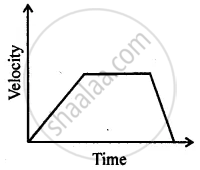
Can you suggest a real-life example about the motion of a body from the following velocity – time graph?
A stone thrown vertically upwards takes 3 s to attain maximum height. Calculate
- initial velocity of the stone
- maximum height attained by the stone. (Take g = 9.8 ms−2)
Draw a velocity versus time graph of a stone thrown vertically upwards and then coming downwards after attaining the maximum height.
When will you say a body is at uniform acceleration?
