Advertisements
Advertisements
Question
A cheetah starts from, rest, and accelerates at 2 m/s2 for 10 seconds. Calculate :
(a) the final velocity
(b) the distance travelled.
Advertisements
Solution
We have to find the distance travelled by the cheetah. We have the following information given,
So, initial velocity, (u) = 0 m/s
Acceleration, (a) = 2 m/s2
Time taken, (t) = 10 s
(a) So, we can find the final velocity using the relation, v = u + at
Final velocity,
v = 0 + (2) (10)
= 20 m/s
(b) We can calculate the distance travelled by cheetah using the 2nd equation of motion,
`s = ut + 1/2 at^2`
Put the values in above equation to find the distance travelled
`(s) = 0(10) + 1/2(2)(10)^2`
= 100 m
APPEARS IN
RELATED QUESTIONS
When will you say a body is at non-uniform acceleration?
A bus decreases its speed from 80 km h−1 to 60 km h−1 in 5 s. Find the acceleration of the bus.
Define velocity. What is the SI unit of velocity ?
A bus running at a speed of 18 km/h is stopped in 2.5 seconds by applying brakes. Calculate the retardation produced.
Which of the following could not be a unit of acceleration?
Write three equations of uniformly accelerated motion relating the initial velocity (u), final velocity (v), time (t), acceleration (a) and displacement (S).
When is the positive acceleration?
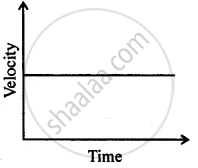
Can you suggest a real-life example about the motion of a body from the following velocity – time graph?
The velocity-time graph (Fig. 8.5) shows the motion of a cyclist. Find (i) its acceleration (ii) its velocity and (iii) the distance covered by the cyclist in 15 seconds.

Draw a velocity versus time graph of a stone thrown vertically upwards and then coming downwards after attaining the maximum height.
