Advertisements
Advertisements
Question
Two stones are thrown vertically upwards simultaneously with their initial velocities u1 and u2 respectively. Prove that the heights reached by them would be in the ratio of `"u"_1^2 : "u"_2^2` (Assume upward acceleration is –g and downward acceleration to be +g)
Advertisements
Solution
At the highest point, v = 0
For the sone thrown with velocity u1
`0 - "u"_1^2 = 2(-"g')h_1` (Using v2 − u2 = 2s)
or `"h"_1 = ("u"_1^2)/(2"g")`
Similarly for the stone thrown with velocity u2,
`"h"_2 = ("u"_2^2)/(2"g")`
∴ The required ratio, `"h"_1/"h"_2 = ("u"_1^2)/(2"g") xx (2"g")/("u"_2^2) = ("u"_1^2)/("u"_2^2)`
APPEARS IN
RELATED QUESTIONS
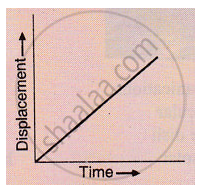
What conclusion can you draw about the velocity of a body from the displacement-time graph shown below :
Name the quantity which is measured by the area occupied under the velocity-time graph.
Derive the formula : v = u + at, where the symbols have usual meanings.
Which of the following could not be a unit of acceleration?
Differentiate between uniform acceleration and variable acceleration.
Write three equations of uniformly accelerated motion relating the initial velocity (u), final velocity (v), time (t), acceleration (a) and displacement (S).
What do you understand by the term acceleration?
A packet is dropped from a stationary helicopter, hovering at a height ‘h’ from ground level, reaches the ground in 12s. Calculate
- the value of h
- final velocity of packet on reaching the ground. (Take g = 9.8 ms−2)
A stone thrown vertically upwards takes 3 s to attain maximum height. Calculate
- initial velocity of the stone
- maximum height attained by the stone. (Take g = 9.8 ms−2)
How will the equations of motion for an object moving with a uniform velocity change?
