Advertisements
Advertisements
Question
A motorcycle moving with a speed of 5 m/s is subjected to an acceleration of 0.2 m/s2. Calculate the speed of the motorcycle after 10 seconds, and the distance travelled in this time.
Advertisements
Solution
We have to find the distance travelled and final velocity of the body. We have the following information given,
Initial velocity, (u) = 5 m/s
Acceleration, (a) = 0.2 m/s2
Time taken, (t) = 10 s
So, we can find the final velocity using the relation,
v = u + at
So, final velocity,
v = 5 + (0.2)(10)
= 7 m/s
We can calculate the distance travelled by using the 2nd equation of motion,
`s = ut + 1/2 at^2`
Put the values in above equation to find the distance travelled by the motorcycle ,
`(s) = 5(10) + 1/2(0.2)(10)^2`
= (50 + 10) m
= 60 m
APPEARS IN
RELATED QUESTIONS
A bus decreases its speed from 80 km h−1 to 60 km h−1 in 5 s. Find the acceleration of the bus.
Name the physical quantity whose SI unit is :
(a) m/s (b) m/s2
What is meant by the term acceleration ? State the SI unit of acceleration.
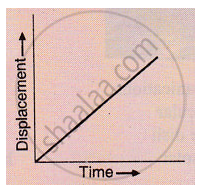
What conclusion can you draw about the velocity of a body from the displacement-time graph shown below :
Explain why, the motion of a body which is moving with constant speed in a circular path is said to be accelerated.
A bus running at a speed of 18 km/h is stopped in 2.5 seconds by applying brakes. Calculate the retardation produced.
A car acquire a velocity of 72 km per hour in 10 second starting from rest. Find
(1) the acceleration,
(2) the average velocity, and
(3) the distance travelled in this time.
The slope of a speed-time graph gives:
When is the negative acceleration?
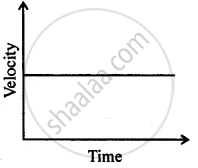
Can you suggest a real-life example about the motion of a body from the following velocity – time graph?