Advertisements
Advertisements
Question
A train starting from stationary position and moving with uniform acceleration attains a speed of 36 km per hour in 10 minutes. Find its acceleration.
Advertisements
Solution
Initial velocity, u=0m/s
Final velocity, v=36km/h=10m/s
Time, t=10min =10 x 60=600 sec
Average velocity =
`"Inition velocity + Final velocity"/"2"`
Thats is, Average velocity= `(u+v)/2`
Also, Distance travelled= Average velocity ×Time
so, s=`((u+v))/2` × t ...............(1)
Form the first equation of motion, we have, v =u+at.
put this value of v in equation (1), we get:
s =`((u+u+at))/2 × t`
or s=`((2u+at)×t)/2`
or s = `(2ut+at^2)/2`
or s = `ut + 1/2 at^2`
where, s =distance travelledby the boby in time t
u= initial velocity of the body
and a= acceleration
Acceleration = `"Final velocity - Initial velocity"/"time taken"`
so, a= `(v-u)/t=( 10-0)/600 =10/600"m//s^2 =1/60m//s^s = 0.016m//s^2`
APPEARS IN
RELATED QUESTIONS
Give one example of a situation in which a body has a certain average speed but its average velocity is zero.
What term is used to denote the change of velocity with time ?
Fill in the following blank with suitable word :
If a body moves with uniform velocity, its acceleration is ..............
When a car driver travelling at a speed of 10 m/s applies brakes and brings the car to rest in 20 s, then retardation will be :
A bus increases its speed from 36 km/h to 72 km/h in 10 seconds. Its acceleration is :
A bicycle initially moving with a velocity 5.0 m s-1 accelerates for 5 s at a rate of 2 m s-2. What will be its final velocity?
Derive the following equations for uniformly accelerated motion:
(i) v = u + at
(ii) `"S = ut" + 1/2 "at"^2`
(iii) v2 = u2 + 2aS
where the symbols have their usual meanings.
How can you find the following?
Velocity from acceleration – time graph.
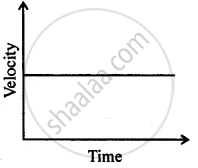
Can you suggest a real-life example about the motion of a body from the following velocity – time graph?
Draw a velocity versus time graph of a stone thrown vertically upwards and then coming downwards after attaining the maximum height.
