Advertisements
Advertisements
Question
A boy is sitting on a merry-go-round which is moving with a constant speed of 10 m s−1. This means that the boy is :
Options
at rest
moving with no acceleration
in accelerated motion
moving with uniform velocity
Advertisements
Solution
in accelerated motion
Acceleration is the rate of change of velocity, and the velocity of the merry-go-round is changing with respect to time. Thus, it will move in an accelerated motion.
APPEARS IN
RELATED QUESTIONS
When will you say a body is at non-uniform acceleration?
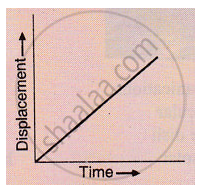
What conclusion can you draw about the velocity of a body from the displacement-time graph shown below :
Describe the motion of a body which is accelerating at a constant rate of 10 m s–2. If the body starts from rest, how much distance will it cover in 2 s ?
A body starting from rest travels with uniform acceleration. If it travels 100 m in 5 s, what is the value of acceleration ?
A body starts from rest and acquires a velocity 10 m s-1 in 2 s. Find the acceleration.
State how the velocity-time graph can be used to find
The acceleration of a body
What do you understand by the term acceleration?
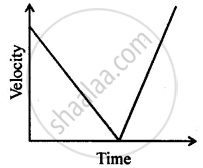
Can you suggest a real-life example about the motion of a body from the following velocity – time graph?
Area under a v – t graph represents a physical quantity which has the unit
The velocity-time graph (Fig. 8.5) shows the motion of a cyclist. Find (i) its acceleration (ii) its velocity and (iii) the distance covered by the cyclist in 15 seconds.

