Advertisements
Advertisements
Question
When will you say a body is at non-uniform acceleration?
Advertisements
Solution
- A body is said to have non-uniform acceleration if it travels in a straight path in such a way that its velocity changes at a non-uniform rate.
- i.e., the velocity of a body increases or decreases in unequal amounts in an equal interval of time.
RELATED QUESTIONS
Define velocity. What is the SI unit of velocity ?
A bus running at a speed of 18 km/h is stopped in 2.5 seconds by applying brakes. Calculate the retardation produced.
Derive the formula s= `ut+1/2at^2` , where the symbols have usual meanings.
When a car driver travelling at a speed of 10 m/s applies brakes and brings the car to rest in 20 s, then retardation will be :
The slope of a speed-time graph gives:
A bicycle initially moving with a velocity 5.0 m s-1 accelerates for 5 s at a rate of 2 m s-2. What will be its final velocity?
Derive the following equations for uniformly accelerated motion:
(i) v = u + at
(ii) `"S = ut" + 1/2 "at"^2`
(iii) v2 = u2 + 2aS
where the symbols have their usual meanings.
A body, initially at rest, starts moving with a constant acceleration 2 m s-2. Calculate: (i) the velocity acquired and (ii) the distance travelled in 5 s.
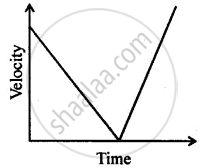
Can you suggest a real-life example about the motion of a body from the following velocity – time graph?
An electron moving with a velocity of 5 × 10⁴ ms−1 enters into a uniform electric field and acquires a uniform acceleration of 104 ms–2 in the direction of its initial motion.
(i) Calculate the time in which the electron would acquire a velocity double of its initial velocity.
(ii) How much distance the electron would cover at this time?
