Advertisements
Advertisements
Question
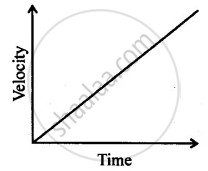
The velocity-time graph (Fig. 8.5) shows the motion of a cyclist. Find (i) its acceleration (ii) its velocity and (iii) the distance covered by the cyclist in 15 seconds.

Advertisements
Solution
Velocity-time graph is a straight line parallel to the time axis, so, the velocity of the cyclist is constant.
(i) Acceleration = 0
(ii) At, f = 15 s velocity = 20 m s’1 (from the given graph)
(iii) Distance covered by the cyclist in 15 s
= Area under v - t graph during that time interval
= 20 ms’1 x 15 s
= 300 m.
APPEARS IN
RELATED QUESTIONS
A train starting from a railway station and moving with uniform acceleration attains a speed 40 km h−1 in 10 minutes. Find its acceleration.
Fill in the following blank with a suitable word:
Acceleration is the rate of change of ______ It is measured in ______
Explain why, the motion of a body which is moving with constant speed in a circular path is said to be accelerated.
A freely falling object travels 4.9 m in 1st second, 14.7 m in 2 nd second, 24.5 m in 3rd second, and so on. This data shows that the motion of a freely falling object is a case of :
When is the negative acceleration?
Can you suggest a real-life example about the motion of a body from the following velocity – time graph?
A stone thrown vertically upwards takes 3 s to attain maximum height. Calculate
- initial velocity of the stone
- maximum height attained by the stone. (Take g = 9.8 ms−2)
A body is thrown vertically upward with velocity u, the greatest height h to which it will rise is,
How will the equations of motion for an object moving with a uniform velocity change?
Draw a velocity versus time graph of a stone thrown vertically upwards and then coming downwards after attaining the maximum height.
