Advertisements
Advertisements
Question
Explain the meaning of the following equation of motion :v = u + at, where symbols have their usual meanings.
Advertisements
Solution
(a) The given equation is the first equation of motion i.e.,
v = u + at
Where,
(a) - Acceleration
(v) - Final velocity
(u) - Initial velocity
(t) - Time taken
It gives the velocity acquired by a body in time t provided initial velocity and acceleration is known
APPEARS IN
RELATED QUESTIONS
A bus decreases its speed from 80 km h−1 to 60 km h−1 in 5 s. Find the acceleration of the bus.
Name the physical quantity whose SI unit is :
(a) m/s (b) m/s2
Fill in the following blank with a suitable word:
Acceleration is the rate of change of ______ It is measured in ______
Describe the motion of a body which is accelerating at a constant rate of 10 m s–2. If the body starts from rest, how much distance will it cover in 2 s ?
A bus was moving with a speed of 54 km/h. On applying brakes it stopped in 8 seconds. Calculate the acceleration.
Multiple choice Question. Select the correct option.
At the maximum height, a body thrown vertically upwards has :
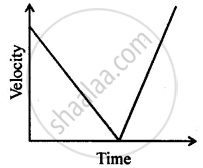
Can you suggest a real-life example about the motion of a body from the following velocity – time graph?
Area under a v – t graph represents a physical quantity which has the unit
The velocity-time graph (Fig. 8.5) shows the motion of a cyclist. Find (i) its acceleration (ii) its velocity and (iii) the distance covered by the cyclist in 15 seconds.

An object starting from rest travels 20 m in the first 2 s and 160 m in the next 4 s. What will be the velocity after 7 s from the start?
