Advertisements
Advertisements
Question
A bus decreases its speed from 80 km h−1 to 60 km h−1 in 5 s. Find the acceleration of the bus.
Advertisements
Solution
Initial velocity = 80km/h
= 80 × 100060 × 60
= 22.22 m/s
Time = 5s
Final velocity v = 60 km/h
= 60 × 100060 × 60
= 16.66 m/s
Acceleration = `"Change in velocity"/"Time taken"`
= `"(Final velocity - Initial velocity)"/"Time taken"`
= `(16.66-22.22 )/5`
= -1.11ms-2
Hence, acceleration of the bus = -1.11ms-2
RELATED QUESTIONS
Fill in the following blank with suitable word :
If a body moves with uniform velocity, its acceleration is ..............
A bus was moving with a speed of 54 km/h. On applying brakes it stopped in 8 seconds. Calculate the acceleration.
Differentiate between uniform acceleration and variable acceleration.
Give one example of following motion :
Variable acceleration
The velocity-time graph of a body in motion is a straight line inclined to the time axis. The correct statement is ___________
For a uniformly retarded motion, the velocity-time graph is _____________
Multiple choice Question. Select the correct option.
At the maximum height, a body thrown vertically upwards has :
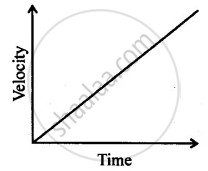
Can you suggest a real-life example about the motion of a body from the following velocity – time graph?
A stone thrown vertically upwards takes 3 s to attain maximum height. Calculate
- initial velocity of the stone
- maximum height attained by the stone. (Take g = 9.8 ms−2)
An object starting from rest travels 20 m in the first 2 s and 160 m in the next 4 s. What will be the velocity after 7 s from the start?
