Advertisements
Advertisements
प्रश्न
A bus decreases its speed from 80 km h−1 to 60 km h−1 in 5 s. Find the acceleration of the bus.
Advertisements
उत्तर
Initial velocity = 80km/h
= 80 × 100060 × 60
= 22.22 m/s
Time = 5s
Final velocity v = 60 km/h
= 60 × 100060 × 60
= 16.66 m/s
Acceleration = `"Change in velocity"/"Time taken"`
= `"(Final velocity - Initial velocity)"/"Time taken"`
= `(16.66-22.22 )/5`
= -1.11ms-2
Hence, acceleration of the bus = -1.11ms-2
संबंधित प्रश्न
Fill in the following blank with a suitable word:
Acceleration is the rate of change of ______ It is measured in ______
A bus was moving with a speed of 54 km/h. On applying brakes it stopped in 8 seconds. Calculate the acceleration.
A car acquire a velocity of 72 km per hour in 10 second starting from rest. Find
(1) the acceleration,
(2) the average velocity, and
(3) the distance travelled in this time.
A boy is sitting on a merry-go-round which is moving with a constant speed of 10 m s−1. This means that the boy is :
If a stone and a pencil are dropped simultaneously in vacuum from the top of a tower, then which of the two will reach the ground first? Give reason.
Can you suggest a real-life example about the motion of a body from the following velocity – time graph?
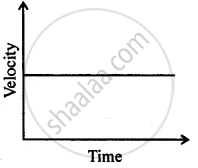
Can you suggest a real-life example about the motion of a body from the following velocity – time graph?
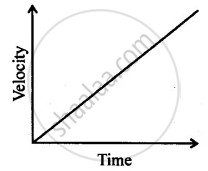
A stone thrown vertically upwards takes 3 s to attain maximum height. Calculate
- initial velocity of the stone
- maximum height attained by the stone. (Take g = 9.8 ms−2)
Draw a velocity versus time graph of a stone thrown vertically upwards and then coming downwards after attaining the maximum height.
Two stones are thrown vertically upwards simultaneously with their initial velocities u1 and u2 respectively. Prove that the heights reached by them would be in the ratio of `"u"_1^2 : "u"_2^2` (Assume upward acceleration is –g and downward acceleration to be +g)
