Advertisements
Advertisements
प्रश्न
When will you say a body is at non-uniform acceleration?
Advertisements
उत्तर
- A body is said to have non-uniform acceleration if it travels in a straight path in such a way that its velocity changes at a non-uniform rate.
- i.e., the velocity of a body increases or decreases in unequal amounts in an equal interval of time.
संबंधित प्रश्न
A bus running at a speed of 18 km/h is stopped in 2.5 seconds by applying brakes. Calculate the retardation produced.
A cheetah starts from, rest, and accelerates at 2 m/s2 for 10 seconds. Calculate :
(a) the final velocity
(b) the distance travelled.
A car is travelling along the road at 8 ms-1. It accelerates at 1 ms-2 for a distance of 18 m. How fast is it then travelling ?
A freely falling object travels 4.9 m in 1st second, 14.7 m in 2 nd second, 24.5 m in 3rd second, and so on. This data shows that the motion of a freely falling object is a case of :
A bus increases its speed from 36 km/h to 72 km/h in 10 seconds. Its acceleration is :
Differentiate between uniform acceleration and variable acceleration.
A body starts from rest and acquires a velocity 10 m s-1 in 2 s. Find the acceleration.
What do you understand by the term acceleration?
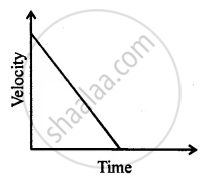
Can you suggest a real-life example about the motion of a body from the following velocity – time graph?
An object starting from rest travels 20 m in the first 2 s and 160 m in the next 4 s. What will be the velocity after 7 s from the start?
