Advertisements
Advertisements
प्रश्न
Find the initial velocity of a car which is stopped in 10 seconds by applying brakes. The retardation due to brakes is 2.5 m/s2.
Advertisements
उत्तर
We have to find the initial velocity.
Final velocity as the car stops after some time, (v) = 0 m/s
Acceleration for the entire journey, (a) = –2.5 m/s2
Time taken is (t) = 10 s
Let the initial velocity be (u)
We can calculate initial velocity using 1st equation of motion as, u = v – at
So initial velocity,
u = 0 – (–2.5)(10)
⇒ u = 25 m/s
APPEARS IN
संबंधित प्रश्न
What term is used to denote the change of velocity with time ?
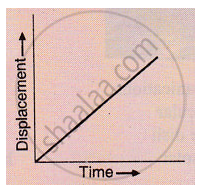
What conclusion can you draw about the velocity of a body from the displacement-time graph shown below :
A train travelling at 20 m s-1 accelerates at 0.5 m s-2 for 30 s. How far will it travel in this time ?
A car acquire a velocity of 72 km per hour in 10 second starting from rest. Find
(1) the acceleration,
(2) the average velocity, and
(3) the distance travelled in this time.
Give one example of following motion :
Variable acceleration
A bicycle initially moving with a velocity 5.0 m s-1 accelerates for 5 s at a rate of 2 m s-2. What will be its final velocity?
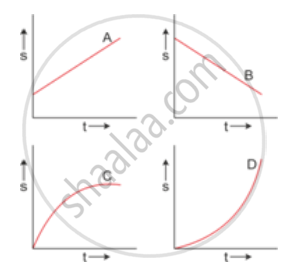
The figure shows the displacement - time graph for four bodies A, B C and D. In each case state what information do you get about the acceleration (zero, positive or negative).
For a uniformly retarded motion, the velocity-time graph is _____________
How will the equations of motion for an object moving with a uniform velocity change?
Two stones are thrown vertically upwards simultaneously with their initial velocities u1 and u2 respectively. Prove that the heights reached by them would be in the ratio of `"u"_1^2 : "u"_2^2` (Assume upward acceleration is –g and downward acceleration to be +g)
