Advertisements
Advertisements
प्रश्न
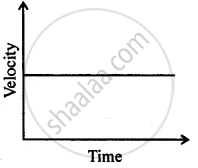
Can you suggest a real-life example about the motion of a body from the following velocity – time graph?
Advertisements
उत्तर
A car running on a road at a constant velocity. Then v – t graph will be same as shown by

APPEARS IN
संबंधित प्रश्न
A bus decreases its speed from 80 km h−1 to 60 km h−1 in 5 s. Find the acceleration of the bus.
A train starting from a railway station and moving with uniform acceleration attains a speed 40 km h−1 in 10 minutes. Find its acceleration.
A motorcycle moving with a speed of 5 m/s is subjected to an acceleration of 0.2 m/s2. Calculate the speed of the motorcycle after 10 seconds, and the distance travelled in this time.
A cheetah starts from, rest, and accelerates at 2 m/s2 for 10 seconds. Calculate :
(a) the final velocity
(b) the distance travelled.
The slope of a speed-time graph gives:
Give one example of following motion :
Variable acceleration
A body, initially at rest, starts moving with a constant acceleration 2 m s-2. Calculate: (i) the velocity acquired and (ii) the distance travelled in 5 s.
When is the negative acceleration?
Multiple choice Question. Select the correct option.
At the maximum height, a body thrown vertically upwards has :
Area under a v – t graph represents a physical quantity which has the unit
