Advertisements
Advertisements
Question
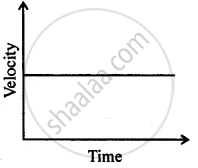
Can you suggest a real-life example about the motion of a body from the following velocity – time graph?
Advertisements
Solution
A car running on a road at a constant velocity. Then v – t graph will be same as shown by

APPEARS IN
RELATED QUESTIONS
Give one example of a situation in which a body has a certain average speed but its average velocity is zero.
Define velocity. What is the SI unit of velocity ?
A train travelling at 20 m s-1 accelerates at 0.5 m s-2 for 30 s. How far will it travel in this time ?
A body starting from rest travels with uniform acceleration. If it travels 100 m in 5 s, what is the value of acceleration ?
A body starts from rest and acquires a velocity 10 m s-1 in 2 s. Find the acceleration.
State how the velocity-time graph can be used to find
The acceleration of a body
Write three equations of uniformly accelerated motion relating the initial velocity (u), final velocity (v), time (t), acceleration (a) and displacement (S).
Multiple choice Question. Select the correct option.
The speed of a car reduces from 15 m/s to 5 m/s over a displacement of 10 m. The uniform acceleration of the car is :
Multiple choice Question. Select the correct option.
At the maximum height, a body thrown vertically upwards has :
Area under a v – t graph represents a physical quantity which has the unit
