Advertisements
Advertisements
Question
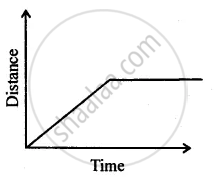
Can you suggest the kind of motion of a body from the following distance – time graph?
Advertisements
Solution
Distance – time graph in the figure shows that initially, the body is in uniform motion i.e. it covers equal distance in equal intervals of time.
From O to A, the body is in uniform motion, and from A to B, the body is at rest.

APPEARS IN
RELATED QUESTIONS
Is displacement a scalar quantity ?
A body when projected up with an initial velocity u goes to a maximum height h in time t and then comes back at the point of projection. The correct statement is ______________
Draw displacement – time graph for the following situation:
When a body is moving with variable velocity.
A motor car slows down from 72 kmh−1 to 36 kmh−1 over a distance of 25 m. If the brakes are applied with the same force
calculate
- total time in which car comes to rest
- distance travelled by it.
Calculate the distance and displacement in the following case: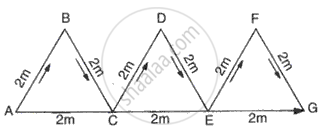
Is distance covered during nth second more than the distance covered in n seconds?
Which of the following is correct?
A car starts from rest and moves along the x-axis with constant acceleration 5 ms–2 for 8 seconds. If it then continues with constant velocity, what distance will the car cover in 12 seconds since it started from the rest?
Obtain a relation for the distance travelled by an object moving with uniform acceleration in the interval between 4th and 5th seconds.
The rate of change of displacement ______.
