Advertisements
Advertisements
Question
A body starts from rest with uniform acceleration 2 m s-2. Find the distance covered by the body in 2 s.
Advertisements
Solution
Initial velocity u = 0
Acceleration a = 2 m/s2
Time t = 2 s
Let 'S' be the distance covered.
Using the second equation of motion,
S = ut + (1/2) at2
S = 0 + (1/2) (2) (2) 2
S = 4 m
APPEARS IN
RELATED QUESTIONS
When is the magnitude of displacement equal to the distance?
From the displacement-time graph of a cyclist given below in the Figure, find The displacement from the initial position at the end of 10 s,
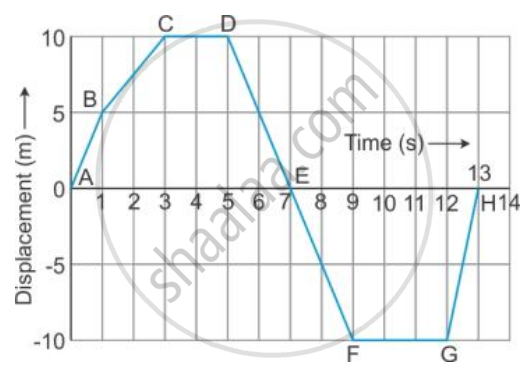
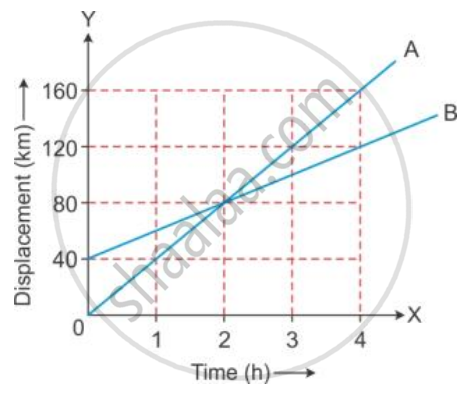
Figure ahead represents the displacement - time sketch of motion of two cars A and B . Find :
(i) the distance by which the car B was initially ahead of car A.
(ii) the velocities of car A and car B.
(iii) the time in which car A catches car B.
(iv) the distance from start when the car A will catch the car B.
A body at rest is made to fall from the top of a tower. Its displacement at different instants is given in the following table:
| Time (in s) | 0.1 | 0.2 | 0.3 | 0.4 | 0.5 | 0.6 |
| Displacement (in m) | 0.05 | 0.20 | 0.45 | 0.80 | 1.25 | 1.80 |
Draw a displacement-time graph and state whether the motion is uniform or non-uniform?
A car starting from rest accelerates uniformly to acquire a speed 20 km h-1 in 30 min. The distance travelled by a car in this time interval will be _____________
Calculate the distance and displacement in the following case: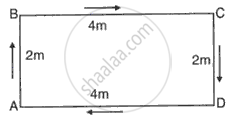
The figure represents graphically the velocity of a car moving along a straight road over a period of 100 hours.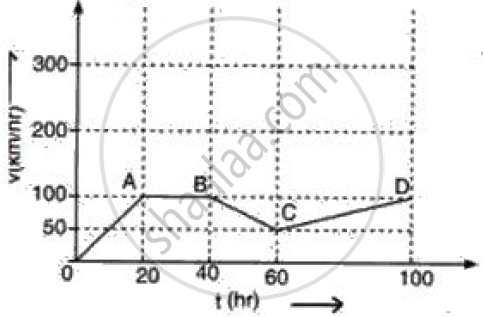
Calculate the distance travelled in the last 40 h.
The table below shows the distance travelled by two vehicles A and B during each second:
| Time (s) | 0 | 1 | 2 | 3 | 4 | 5 | 6 | 7 |
| Distance travelled by A (m) | 0 | 20 | 80 | 180 | 240 | 300 | 360 | 420 |
| Distance travelled by B (m) | 0 | 10 | 40 | 90 | 160 | 250 | 360 | 490 |
Which vehicle is moving with uniform velocity?
______ is the length of the actual path covered by a body.
The displacement is zero when the initial and final positions are ______.
