Advertisements
Advertisements
Question
Give two differences between displacement and distance.
Advertisements
Solution
Differences between displacement and distance.
Distance:
- It is a scalar quantity.
- Distance travelled is always positive.
- The distance travelled by a moving body is the actual length of path.
- Distance travelled is always greater than or equal to the displacement.
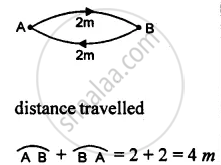
Displacement:
- It is a vector quantity.
- Displacement may be positive negative or zero.
- The displacement of a body is the shortest distance between the initial and final positions of the body.
- Displacement is always less than or equal to the distance travelled.
Displacement is zero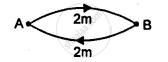
APPEARS IN
RELATED QUESTIONS
Differentiate between distance and displacement.
What can you say about the nature of motion of a body if its displacement-time graph is A straight line inclined to the time axis with an obtuse angle?
The following table gives the displacement of a car at different instants of time.
| Time (s) | 0 | 1 | 2 | 3 | 4 |
| Displacement (m) | 0 | 5 | 10 | 15 | 20 |
- Draw the displacement-time sketch and find the average velocity of the car.
- What will be the displacement of the car at (i) 2.5 s and (ii) 4.5 s?
Define Distance.
A motorbike running at 90 kmh−1, is slowed down to 54 kmh−1 by the application of brakes, over a distance of 40 m. If the brakes are applied with the same force, calculate
- total time in which bike comes to rest
- total distance travelled by bike.
Name the physical quantity associated with the rate of change of displacement with time.
The figure represents graphically the velocity of a car moving along a straight road over a period of 100 hours.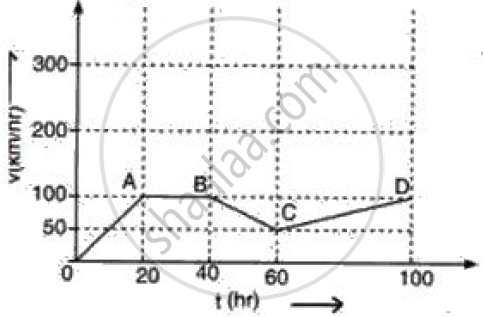
Calculate the distance travelled in the last 40 h.
The table below shows the distance travelled by two vehicles A and B during each second:
| Time (s) | 0 | 1 | 2 | 3 | 4 | 5 | 6 | 7 |
| Distance travelled by A (m) | 0 | 20 | 80 | 180 | 240 | 300 | 360 | 420 |
| Distance travelled by B (m) | 0 | 10 | 40 | 90 | 160 | 250 | 360 | 490 |
Which vehicle is ahead at the end of 7th second and by how much?
Give some examples for vector quantity.
A body is projected up with an initial velocity of u m/s. It goes up to a height, ‘h’ meters in seconds' time. Then it comes back at the point of projection.
Considering negligible air resistance, which of the following statement is true?
