Advertisements
Advertisements
प्रश्न
Give two differences between displacement and distance.
Advertisements
उत्तर
Differences between displacement and distance.
Distance:
- It is a scalar quantity.
- Distance travelled is always positive.
- The distance travelled by a moving body is the actual length of path.
- Distance travelled is always greater than or equal to the displacement.
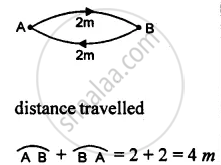
Displacement:
- It is a vector quantity.
- Displacement may be positive negative or zero.
- The displacement of a body is the shortest distance between the initial and final positions of the body.
- Displacement is always less than or equal to the distance travelled.
Displacement is zero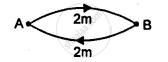
APPEARS IN
संबंधित प्रश्न
A farmer moves along the boundary of a square field of side 10 m in 40 s. What will be the magnitude of displacement of the farmer at the end of 2 minutes 20 seconds?
In which of the following cases of motion, the distance moved and the magnitude of displacement are equal?
Differentiate between distance and displacement.
A train takes 3 h to travel from Agra to Delhi with a uniform speed of 65 km h-1. Find the distance between the two cities.
A racehorse runs straight towards the north and covers 540 m in one minute. Calculate
- displacement of the horse,
- its velocity in (a) ms−1 (b) kmh−1.
A motorbike running at 90 kmh−1, is slowed down to 54 kmh−1 by the application of brakes, over a distance of 40 m. If the brakes are applied with the same force, calculate
- total time in which bike comes to rest
- total distance travelled by bike.
Write the SI units for measurement of distance and displacement.
A particle is moving in a circular pattern of radius r. The displacement after half a circle would be ______.
The rate of change of displacement ______.
If the displacement-time graph of a particle is parallel to the time axis, the velocity of the particle is ______.
