Advertisements
Advertisements
प्रश्न
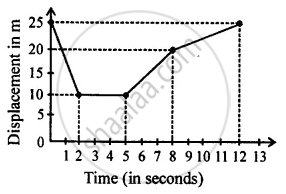
From the displacement – time graph shown given below calculate :
- Velocity between 0 – 2 s.
- Velocity between 8 s – 12 s.
- Average velocity between 5 s – 12 s.
Advertisements
उत्तर
1. Velocity between 0 – 2 s = `(-(25-10))/2` .......[negative sign because slope is negative]
= `-15/2`
= −7.5 ms−1
2. Velocity between 8 s – 12 s = `(25-20)/(12-8)=5/4`
= 1.25 ms−1
3. Average velocity between 5 s – 12 s
= `"Total displacement from 5 s to 12 s"/"Time"`
= `(25-10)/(12-5)`
= `15/7`
= 2.1 ms−1
APPEARS IN
संबंधित प्रश्न
A body travels a distance of 3 km towards East, then 4 km towards North and finally 9 km towards East.
What is the total distance travelled ?
Is displacement a scalar quantity?
Define Displacement.
How can you find the following?
Displacement from velocity – time graph.
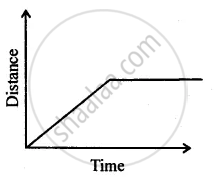
Can you suggest the kind of motion of a body from the following distance – time graph?
Can a body have negative displacement?
Four cars A, B, C, and D are moving on a levelled road. Their distance versus time graphs are shown in Fig. 8.2. Choose the correct statement.

Using the following data, draw time - displacement graph for a moving object:
| Time (s) | 0 | 2 | 4 | 6 | 8 | 10 | 12 | 14 | 16 |
| Displacement (m) | 0 | 2 | 4 | 4 | 4 | 6 | 4 | 2 | 0 |
Use this graph to find average velocity for the first 4 s, for the next 4 s and for the last 6 s.
Displacement can be zero but distance never.
Assertion: If the displacement of the body is zero, the distance covered by it may not be zero.
Reason: Displacement is a vector & distance is a scalar quantity.
