Advertisements
Advertisements
प्रश्न
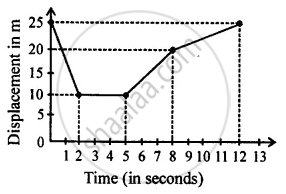
From the displacement – time graph shown given below calculate :
- Velocity between 0 – 2 s.
- Velocity between 8 s – 12 s.
- Average velocity between 5 s – 12 s.
Advertisements
उत्तर
1. Velocity between 0 – 2 s = `(-(25-10))/2` .......[negative sign because slope is negative]
= `-15/2`
= −7.5 ms−1
2. Velocity between 8 s – 12 s = `(25-20)/(12-8)=5/4`
= 1.25 ms−1
3. Average velocity between 5 s – 12 s
= `"Total displacement from 5 s to 12 s"/"Time"`
= `(25-10)/(12-5)`
= `15/7`
= 2.1 ms−1
APPEARS IN
संबंधित प्रश्न
In which of the following cases of motion, the distance moved and the magnitude of displacement are equal?
State how the velocity-time graph can be used to find The distance travelled by the body in a given time
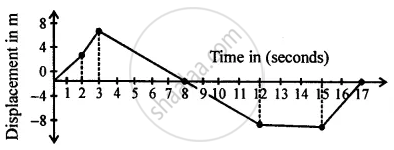
From the displacement – time graph shown given below calculate:
- Average velocity in the first three seconds.
- Displacement from the initial position at the end of 13 s.
- Time after which the body is at the initial position,
- Average velocity after 8 s.
Can a body have negative displacement?
A body is moving along a circular path of radius r. What will be the distance and displacement of the body when it completes:
Full revolution
State whether true or false. If false, correct the statement.
Distance covered by a particle never becomes zero but displacement becomes zero.
Which of the following is correct?
Give one example where the displacement is zero but the distance travelled is not zero.
Choose the correct option.
Distance travelled by a freely falling body is proportional to ______.
