Advertisements
Advertisements
प्रश्न
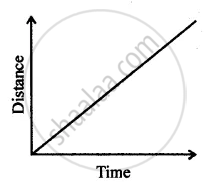
Can you suggest the kind of motion of a body from the following distance – time graph?
Advertisements
उत्तर
Distance – time graph in the figure shows that body is in uniform motion.
APPEARS IN
संबंधित प्रश्न
Is displacement a scalar quantity ?
A body is moving along a circular path of radius R. What will be the distance travelled and displacement of the body when it completes half a revolution ?
If on a round trip you travel 6 km and then arrive back home :
What distance have you travelled ?
In which of the following cases of motion, the distance moved and the magnitude of displacement are equal?
A car travels a distance 100 m with constant acceleration and average velocity of 20 ms-1. The final velocity acquired by the car is 25 ms-1.
Find
(i) The initial velocity.
(ii) Acceleration of the car.
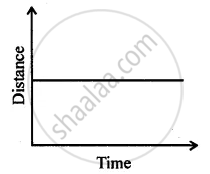
Can you suggest the kind of motion of a body from the following distance – time graph?
Show the difference between distance and displacement with the help of a diagram.
The table below shows the distance travelled by two vehicles A and B during each second:
| Time (s) | 0 | 1 | 2 | 3 | 4 | 5 | 6 | 7 |
| Distance travelled by A (m) | 0 | 20 | 80 | 180 | 240 | 300 | 360 | 420 |
| Distance travelled by B (m) | 0 | 10 | 40 | 90 | 160 | 250 | 360 | 490 |
Which vehicle is ahead at the end of 7th second and by how much?
Give some examples for vector quantity.
In which of the following cases of motions, the distance moved and the magnitude of displacement are equal?
