Advertisements
Advertisements
प्रश्न
A body is moving along a circular path of radius R. What will be the distance travelled and displacement of the body when it completes half a revolution ?
Advertisements
उत्तर
We have to analyse the distance and displacement of a body that has covered half the perimeter of a circle.
Distance travelled in half a rotation of a circular path is equal to the circumference of semi-circle.
Distance travelled = πR
Displacement is calculated from the initial and final positions of a body. It is independent of the path covered. So, displacement is the diameter of the semi-circle.
Hence, displacement is 2R, where R is the radius of the circular path.
APPEARS IN
संबंधित प्रश्न
An athlete completes one round of a circular track of diameter 200 m in 40 s. What will be the distance covered and the displacement at the end of 2 minutes 20 s?
If on a round trip you travel 6 km and then arrive back home :
What distance have you travelled ?
A body is moving in a straight line and its displacement at various instants of time is given in the following table
| Time (s) | 0 | 1 | 2 | 3 | 4 | 5 | 6 | 7 |
| Displacement (m) | 2 | 6 | 12 | 12 | 12 | 18 | 22 | 24 |
Plot the displacement-time graph and calculate
(i) Total distance travelled in the interval 1 s to 5 s.
(ii) Average velocity in time interval 1 s to 5 s.
Figure given below shows a velocity-time graph for a car starting from rest. The graph has three parts AB, BC and CD.
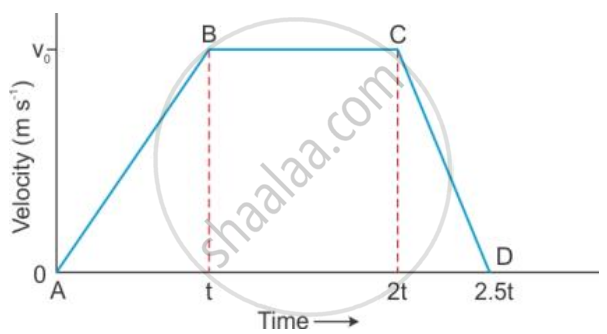
State how is the distance travelled in any part determined from this graph .
Give two differences between displacement and distance.
Draw displacement – time graph for the following situation:
When a body is moving with uniform velocity.
The table below shows the distance travelled by two vehicles A and B during each second:
| Time (s) | 0 | 1 | 2 | 3 | 4 | 5 | 6 | 7 |
| Distance travelled by A (m) | 0 | 20 | 80 | 180 | 240 | 300 | 360 | 420 |
| Distance travelled by B (m) | 0 | 10 | 40 | 90 | 160 | 250 | 360 | 490 |
Give the value of the velocity at which they are meeting
The displacement is zero when the initial and final positions are ______.
A scalar quantity has ______.
An ant moves from one corner of a room diagonally to the opposite corner. If the dimensions of the hall are 8m x 6m, the displacement of the ant is ______.
