Advertisements
Advertisements
प्रश्न
Which of the following could not be a unit of acceleration?
पर्याय
km/s2
cm s−2
km/s
m/s2
Advertisements
उत्तर
km/s
Acceleration is defined as the rate of change of velocity.
APPEARS IN
संबंधित प्रश्न
Give one example of a situation in which a body has a certain average speed but its average velocity is zero.
Fill in the following blank with suitable word :
If a body moves with uniform velocity, its acceleration is ..............
Find the initial velocity of a car which is stopped in 10 seconds by applying brakes. The retardation due to brakes is 2.5 m/s2.
A motorcycle moving with a speed of 5 m/s is subjected to an acceleration of 0.2 m/s2. Calculate the speed of the motorcycle after 10 seconds, and the distance travelled in this time.
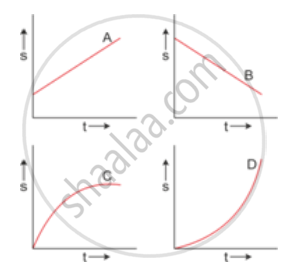
The figure shows the displacement - time graph for four bodies A, B C and D. In each case state what information do you get about the acceleration (zero, positive or negative).
The velocity-time graph of a body in motion is a straight line inclined to the time axis. The correct statement is ___________
A body, initially at rest, starts moving with a constant acceleration 2 m s-2. Calculate: (i) the velocity acquired and (ii) the distance travelled in 5 s.
A body is thrown vertically upward with velocity u, the greatest height h to which it will rise is,
Area under a v – t graph represents a physical quantity which has the unit
How will the equations of motion for an object moving with a uniform velocity change?
