Advertisements
Advertisements
प्रश्न
A body is moving along a circular path of radius R. What will be the distance travelled and displacement of the body when it completes half a revolution ?
Advertisements
उत्तर
We have to analyse the distance and displacement of a body that has covered half the perimeter of a circle.
Distance travelled in half a rotation of a circular path is equal to the circumference of semi-circle.
Distance travelled = πR
Displacement is calculated from the initial and final positions of a body. It is independent of the path covered. So, displacement is the diameter of the semi-circle.
Hence, displacement is 2R, where R is the radius of the circular path.
APPEARS IN
संबंधित प्रश्न
What is the difference between distance travelled by a body and its displacement ? Explain with the
help of a diagram.
Define displacement. State its unit.
A train takes 3 h to travel from Agra to Delhi with a uniform speed of 65 km h-1. Find the distance between the two cities.
What can you say about the nature of motion of a body if its displacement-time graph is A straight line inclined to the time axis with an acute angle?
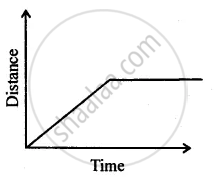
Can you suggest the kind of motion of a body from the following distance – time graph?
The table below shows the distance travelled by two vehicles A and B during each second:
| Time (s) | 0 | 1 | 2 | 3 | 4 | 5 | 6 | 7 |
| Distance travelled by A (m) | 0 | 20 | 80 | 180 | 240 | 300 | 360 | 420 |
| Distance travelled by B (m) | 0 | 10 | 40 | 90 | 160 | 250 | 360 | 490 |
Which vehicle is moving with uniform velocity?
The shortest distance between two places is ______.
Displacement / Time : Velocity :: Speed / Time : ______.
A quantity that has both magnitude and direction is ______.
Displacement magnitude can be greater than the distance traveled by the object.
