Advertisements
Advertisements
प्रश्न
An ant travels a distance of 8 cm from P to Q and then moves a distance of 6 cm at right angles to PQ. Find its resultant displacement.
Advertisements
उत्तर १
We have to find the resultant displacement from the given diagram :
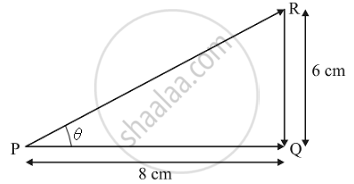
We have:
PQ = 8 cm and QR = 6 cm
Resultant displacement :
`PR = sqrt(PQ^2 + QR^2)`
= `sqrt(64+36)`
= `sqrt(100)`
= 10 cm
The direction of this displacement is from P to R. If θ is the angle made by PR with PQ then,'
`tan θ = "RQ"/"PQ"`
⇒ `tan θ = 36/64`
⇒ `θ = tan^-1 0.5625`
⇒ `θ = 29.36^circ`
This is the angle made by the resultant with PQ.
उत्तर २
To find the resultant displacement, we treat the movement of the ant as forming a right triangle, where:
- The distance from P to Q is 8 cm (one leg of the triangle).
- The distance moved at a right angle to PQ is 6 cm (the other leg of the triangle).
The resultant displacement is the hypotenuse of this right triangle, which can be calculated using the Pythagorean theorem:
Resultant displacement = `sqrt((8^2 + 6^2)`
Resultant displacement = `sqrt(64+36) = sqrt100 = 10 cm.`
The resultant displacement is 10 cm.
APPEARS IN
संबंधित प्रश्न
Is displacement a scalar quantity ?
Is displacement a scalar quantity?
If the displacement of an object is proportional to the square of time, then the object is moving with :
What can you say about the nature of motion of a body if its displacement-time graph is A straight line inclined to the time axis with an obtuse angle?
Figure given below shows a velocity-time graph for a car starting from rest. The graph has three parts AB, BC and CD.
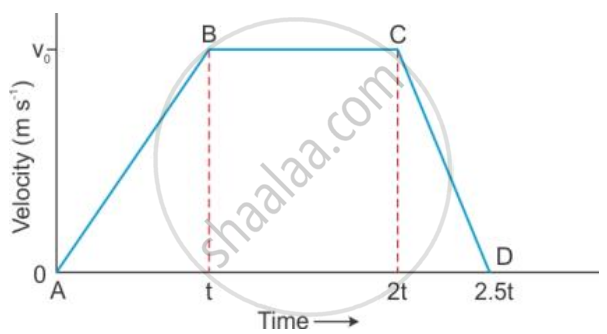
State how is the distance travelled in any part determined from this graph .
A body is moving along a circular path of radius r. What will be the distance and displacement of the body when it completes:
Half a revolution
A body is moving along a circular path of radius r. What will be the distance and displacement of the body when it completes:
Full revolution
Ashok starts from his house and travels 3 km to reach his school. On finding the school gates closed, he returns to his house. What is?
The displacement of Ashok
Slope of a velocity-time graph gives
A body is projected up with an initial velocity of u m/s. It goes up to a height, ‘h’ meters in seconds' time. Then it comes back at the point of projection.
Considering negligible air resistance, which of the following statement is true?
