Advertisements
Advertisements
प्रश्न
Under what conditions can a body travel a certain distance and yet its resultant displacement be zero ?
Advertisements
उत्तर
When the body comes back to its starting point, its resultant displacement is zero. It is because it has covered a certain distance in due course of time; however, there is no difference between the initial and final positions.
APPEARS IN
संबंधित प्रश्न
A body travels a distance of 3 km towards East, then 4 km towards North and finally 9 km towards East.
What is the resultant displacement ?
What can you say about the nature of motion of a body if its displacement-time graph is A straight line parallel to the time axis?
The following table gives the displacement of a car at different instants of time.
| Time (s) | 0 | 1 | 2 | 3 | 4 |
| Displacement (m) | 0 | 5 | 10 | 15 | 20 |
- Draw the displacement-time sketch and find the average velocity of the car.
- What will be the displacement of the car at (i) 2.5 s and (ii) 4.5 s?
A body is moving in a straight line and its displacement at various instants of time is given in the following table
| Time (s) | 0 | 1 | 2 | 3 | 4 | 5 | 6 | 7 |
| Displacement (m) | 2 | 6 | 12 | 12 | 12 | 18 | 22 | 24 |
Plot the displacement-time graph and calculate
(i) Total distance travelled in the interval 1 s to 5 s.
(ii) Average velocity in time interval 1 s to 5 s.
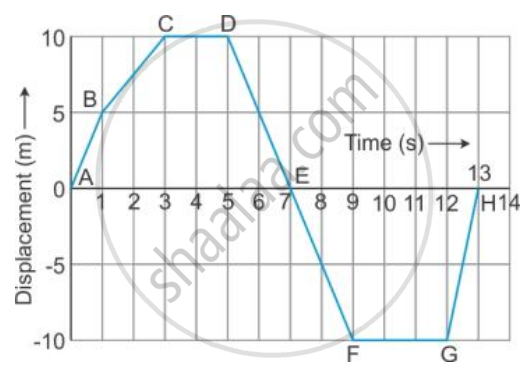
From the displacement-time graph of a cyclist given below in the Figure, find The displacement from the initial position at the end of 10 s,
Distinguish distance and displacement.
______ is the length of the actual path covered by a body.
Write a note on the following:
knot
Slope of a velocity-time graph gives
In which of the following cases of motions, the distance moved and the magnitude of displacement are equal?
