Advertisements
Advertisements
प्रश्न
Under what conditions can a body travel a certain distance and yet its resultant displacement be zero ?
Advertisements
उत्तर
When the body comes back to its starting point, its resultant displacement is zero. It is because it has covered a certain distance in due course of time; however, there is no difference between the initial and final positions.
APPEARS IN
संबंधित प्रश्न
State whether distance is a scalar or a vector quantity.
A racehorse runs straight towards the north and covers 540 m in one minute. Calculate
- displacement of the horse,
- its velocity in (a) ms−1 (b) kmh−1.
Show the difference between distance and displacement with the help of a diagram.
The figure represents graphically the velocity of a car moving along a straight road over a period of 100 hours.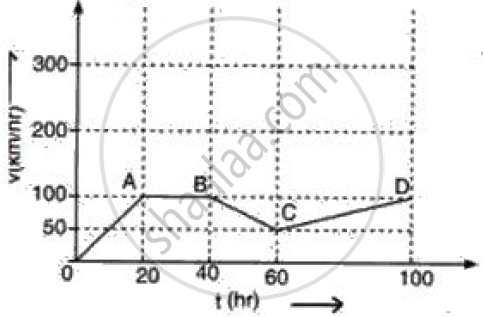
Calculate the distance travelled in the last 40 h.
Give some examples for vector quantity.
The rate of change of displacement ______.
The displacement covered by the second hand of radius V in a clock after one revolution is ______.
A quantity that has both magnitude and direction is ______.
Distance travelled by a freely falling body is proportional to ______.
Displacement is the ______ distance covered by a body.
