Advertisements
Advertisements
प्रश्न
A body travels a distance of 3 km towards East, then 4 km towards North and finally 9 km towards East.
What is the resultant displacement ?
Advertisements
उत्तर
The body travels a total distance of 12 km east, which means towards the x-axis, on a Cartesian plane. It travels a distance of 4 km in north direction, which means towards y-axis.
Resultant displacement :
`sqrt(12^2+4^2)`
= `sqrt(144 + 16)`
= `sqrt(160)`
= 12.65 km
APPEARS IN
संबंधित प्रश्न
A farmer moves along the boundary of a square field of side 10 m in 40 s. What will be the magnitude of displacement of the farmer at the end of 2 minutes 20 seconds?
A car travels a distance 100 m with constant acceleration and average velocity of 20 ms-1. The final velocity acquired by the car is 25 ms-1.
Find
(i) The initial velocity.
(ii) Acceleration of the car.
Write the SI units for measurement of distance and displacement.
Show the difference between distance and displacement with the help of a diagram.
Is distance covered during nth second more than the distance covered in n seconds?
The graph shows how the velocity of a scooter varies with time in 50 s.
Work out: The distance traveled in 10 s, 20 s, and 50 s.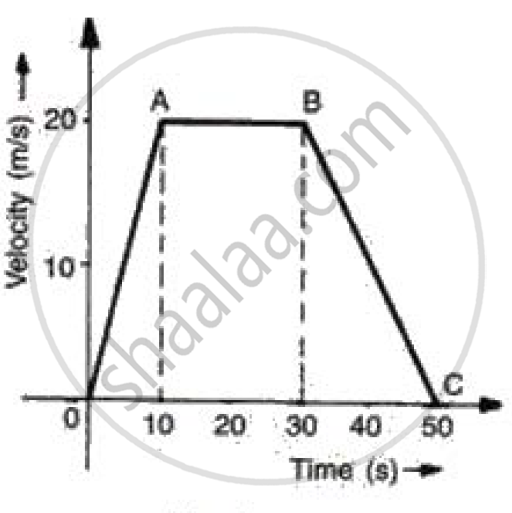
Give one example where the displacement is zero but the distance travelled is not zero.
Is displacement a scalar quantity?
A car starts from rest and moves along the x-axis with constant acceleration 5 ms–2 for 8 seconds. If it then continues with constant velocity, what distance will the car cover in 12 seconds since it started from the rest?
A body is projected up with an initial velocity of u m/s. It goes up to a height, ‘h’ meters in seconds' time. Then it comes back at the point of projection.
Considering negligible air resistance, which of the following statement is true?
