Advertisements
Advertisements
Question
A body travels a distance of 3 km towards East, then 4 km towards North and finally 9 km towards East.
What is the resultant displacement ?
Advertisements
Solution
The body travels a total distance of 12 km east, which means towards the x-axis, on a Cartesian plane. It travels a distance of 4 km in north direction, which means towards y-axis.
Resultant displacement :
`sqrt(12^2+4^2)`
= `sqrt(144 + 16)`
= `sqrt(160)`
= 12.65 km
APPEARS IN
RELATED QUESTIONS
Is displacement a scalar quantity?
When brakes are applied to a bus, retardation produced is 25 cm s-2 and the bus takes 20 s to stop. Calculate -
- The initial velocity of the bus
- The distance travelled by bus during this time.
Copy the following table and fill in the blank spaces.
| Quantity | S.I. Unit | Scalar or Vector |
| Displacement | ___________ | ___________ |
How can you find the following?
Velocity from a displacement – time graph.
Ashok starts from his house and travels 3 km to reach his school. On finding the school gates closed, he returns to his house. What is?
The distance traveled by Ashok.
A body moves along a circular path of radius r. When it completes three complete rounds, what is the ratio of distance covered to its displacement?
The figure represents graphically the velocity of a car moving along a straight road over a period of 100 hours.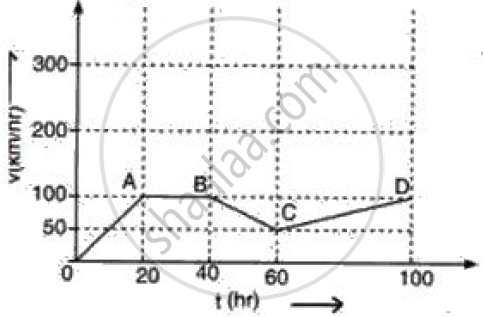
Calculate the distance travelled in the last 40 h.
The table below shows the distance travelled by two vehicles A and B during each second:
| Time (s) | 0 | 1 | 2 | 3 | 4 | 5 | 6 | 7 |
| Distance travelled by A (m) | 0 | 20 | 80 | 180 | 240 | 300 | 360 | 420 |
| Distance travelled by B (m) | 0 | 10 | 40 | 90 | 160 | 250 | 360 | 490 |
At what time do A and B meet?Which vehicle is moving with a constant acceleration?
A particle is moving in a circular path of radius r. The displacement after half a circle would be
Which of the following figures represent uniform motion of a moving object correctly?
