Advertisements
Advertisements
Question
An ant travels a distance of 8 cm from P to Q and then moves a distance of 6 cm at right angles to PQ. Find its resultant displacement.
Advertisements
Solution 1
We have to find the resultant displacement from the given diagram :
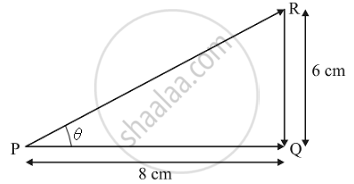
We have:
PQ = 8 cm and QR = 6 cm
Resultant displacement :
`PR = sqrt(PQ^2 + QR^2)`
= `sqrt(64+36)`
= `sqrt(100)`
= 10 cm
The direction of this displacement is from P to R. If θ is the angle made by PR with PQ then,'
`tan θ = "RQ"/"PQ"`
⇒ `tan θ = 36/64`
⇒ `θ = tan^-1 0.5625`
⇒ `θ = 29.36^circ`
This is the angle made by the resultant with PQ.
Solution 2
To find the resultant displacement, we treat the movement of the ant as forming a right triangle, where:
- The distance from P to Q is 8 cm (one leg of the triangle).
- The distance moved at a right angle to PQ is 6 cm (the other leg of the triangle).
The resultant displacement is the hypotenuse of this right triangle, which can be calculated using the Pythagorean theorem:
Resultant displacement = `sqrt((8^2 + 6^2)`
Resultant displacement = `sqrt(64+36) = sqrt100 = 10 cm.`
The resultant displacement is 10 cm.
APPEARS IN
RELATED QUESTIONS
Define displacement. State its unit.
The following table gives the displacement of a car at different instants of time.
| Time (s) | 0 | 1 | 2 | 3 | 4 |
| Displacement (m) | 0 | 5 | 10 | 15 | 20 |
- Draw the displacement-time sketch and find the average velocity of the car.
- What will be the displacement of the car at (i) 2.5 s and (ii) 4.5 s?
Draw displacement – time graph for the following situation:
When a body is moving with uniform velocity.
How can you find the following?
Velocity from a displacement – time graph.
How can you find the following?
Displacement from velocity – time graph.
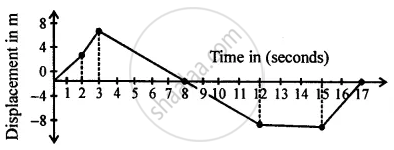
From the displacement – time graph shown given below calculate:
- Average velocity in the first three seconds.
- Displacement from the initial position at the end of 13 s.
- Time after which the body is at the initial position,
- Average velocity after 8 s.
Geetha takes 15 minutes from her house to reach her school on a bicycle. If the bicycle has a speed of 2 m/s, calculate the distance between her house and the school.
A body moves is a circle of radius ‘2R’ what is the distance covered and displacement of the body after 2 complete rounds?
A car starts from rest and moves along the x-axis with constant acceleration 5 ms–2 for 8 seconds. If it then continues with constant velocity, what distance will the car cover in 12 seconds since it started from the rest?
An ant moves from one corner of a room diagonally to the opposite corner. If the dimensions of the hall are 8m x 6m, the displacement of the ant is ______.
