Advertisements
Advertisements
Question
Define displacement. State its unit.
Advertisements
Solution
The shortest distance from the initial to the final position of the body is called the magnitude of displacement. It is in the direction from the initial position to the final position.
Its SI unit is metre (m).
APPEARS IN
RELATED QUESTIONS
What is the difference between distance travelled by a body and its displacement ? Explain with the
help of a diagram.
An ant travels a distance of 8 cm from P to Q and then moves a distance of 6 cm at right angles to PQ. Find its resultant displacement.
A body travels a distance of 3 km towards East, then 4 km towards North and finally 9 km towards East.
What is the total distance travelled ?
State how the velocity-time graph can be used to find The displacement of the body in a given time.
A car covers 90 km in `1 1/2` hours towards east. Calculate
- displacement of car,
- its velocity in (a) kmh−1 (b) ms−1.
Give the name of the physical quantity that corresponds to the rate of change of displacement.
The graph shows how the velocity of a scooter varies with time in 50 s.
Work out: The distance traveled in 10 s, 20 s, and 50 s.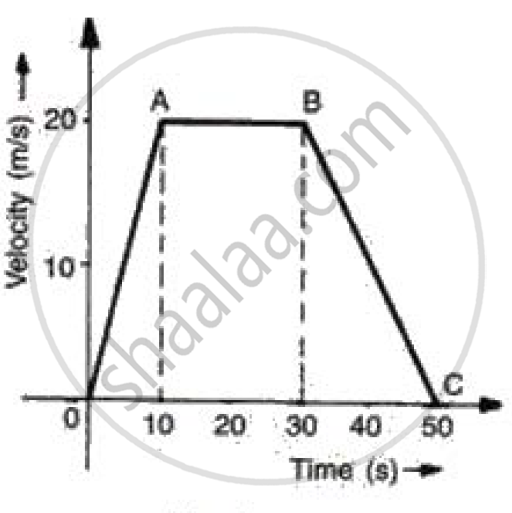
Distance is a ______ quantity.
Give some examples for vector quantity.
Displacement can be zero but distance never.
