Advertisements
Advertisements
Question
An object is thrown vertically upwards. It rises upto a height H and then returns to its initial position. Calculate
The total distance traveled by the object
Advertisements
Solution
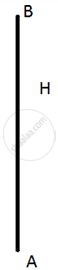
Total dist ance travelled = dist ance from A to B +distance from B to A
So total distance = H +H = 2H.
APPEARS IN
RELATED QUESTIONS
Can displacement be zero even if the distance is not zero? Give one example to explain your answer.
A body when projected up with an initial velocity u goes to a maximum height h in time t and then comes back at the point of projection. The correct statement is ______________
A body at rest is made to fall from the top of a tower. Its displacement at different instants is given in the following table:
| Time (in s) | 0.1 | 0.2 | 0.3 | 0.4 | 0.5 | 0.6 |
| Displacement (in m) | 0.05 | 0.20 | 0.45 | 0.80 | 1.25 | 1.80 |
Draw a displacement-time graph and state whether the motion is uniform or non-uniform?
Give an example of a body which covers a certain distance, but its displacement is zero.
Draw displacement – time graph for the following situation:
When a body is moving with variable velocity.
How can you find the following?
Velocity from a displacement – time graph.
Give the name of the physical quantity that corresponds to the rate of change of displacement.
Name the physical quantity associated with the rate of change of displacement with time.
The table below shows the distance travelled by two vehicles A and B during each second:
| Time (s) | 0 | 1 | 2 | 3 | 4 | 5 | 6 | 7 |
| Distance travelled by A (m) | 0 | 20 | 80 | 180 | 240 | 300 | 360 | 420 |
| Distance travelled by B (m) | 0 | 10 | 40 | 90 | 160 | 250 | 360 | 490 |
Which vehicle is moving with a constant acceleration?
Assertion: Displacement of a body may be zero when distance travelled by it is not zero.
Reason: The displacement is the shortest distance between initial and final position.
