Advertisements
Advertisements
Question
How can you find the following?
Velocity from a displacement – time graph.
Advertisements
Solution
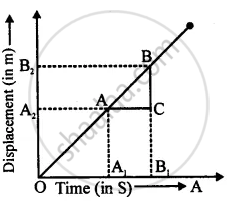
Velocity from a displacement – time graph: Displacement time graph for uniform motion in a straight line (OP) inclined to the time axis. Take any two points A and B on this graph OP. From A and B, draw perpendiculars on the time axis as well as the displacement axis.
So, by knowing the slope of displacement – time graph. We can find the velocity of the body.
Such that,
OA1 = t1, OB1 = t2, OA2 = x1 and OB2 = x2
Slope of displacement – time graph = `"BC"/"AC"`
= `("x"_2-"x"_1)/("t"_2-"t"_1)=(Δ"x")/(Δ"t")` = Velocity of the body
APPEARS IN
RELATED QUESTIONS
An ant travels a distance of 8 cm from P to Q and then moves a distance of 6 cm at right angles to PQ. Find its resultant displacement.
If the displacement of an object is proportional to the square of time, then the object is moving with :
Draw a velocity-time graph for a body moving with an initial velocity u and uniform acceleration a. Use this graph to find the distance travelled by the body in time t.
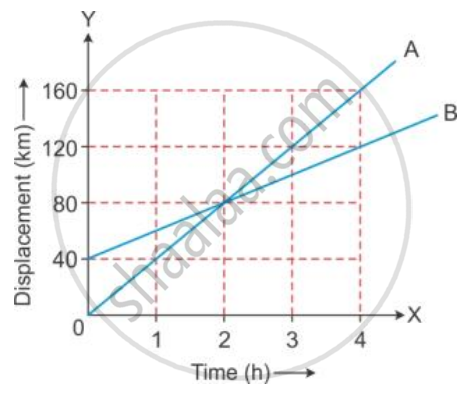
Figure ahead represents the displacement - time sketch of motion of two cars A and B . Find :
(i) the distance by which the car B was initially ahead of car A.
(ii) the velocities of car A and car B.
(iii) the time in which car A catches car B.
(iv) the distance from start when the car A will catch the car B.
A motor car slows down from 72 kmh−1 to 36 kmh−1 over a distance of 25 m. If the brakes are applied with the same force
calculate
- total time in which car comes to rest
- distance travelled by it.
A body is moving along a circular path of radius r. What will be the distance and displacement of the body when it completes:
`(3/4)` th of a revolution
Which of the following is correct?
The displacement covered by the second hand of radius V in a clock after one revolution is ______.
Displacement is the ______ distance covered by a body.
Assertion: If the displacement of the body is zero, the distance covered by it may not be zero.
Reason: Displacement is a vector & distance is a scalar quantity.
