Advertisements
Advertisements
Question
Draw velocity – time graph for the following situation:
When a body is moving with variable velocity and variable acceleration.
Advertisements
Solution
Following is the velocity-time graph:
When a body is moving with variable velocity and variable acceleration

APPEARS IN
RELATED QUESTIONS
Give a scientific reason.
When an object falls freely to the ground, its acceleration is uniform.
Give one example of the following motion:
Uniform retardation
A body is moving vertically upwards. Its velocity changes at a constant rate from 50 m s−1 to 20 m s−1 in 3 s. What is its acceleration?
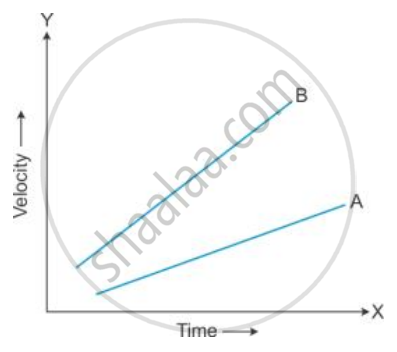
Figure shows the velocity-time graphs for two cars A and B moving in the same direction. Which car has greater acceleration? Give reasons to your answer.
A bullet initially moving with a velocity 20 m/s strikes a target and comes to rest after penetrating a distance 10 cm into the target. Calculate the retardation caused by the target.
A body falls towards the earth. Does it have positive or negative acceleration?
Can you use the relation [B1]?
State if the following situation is possible:
A body moving horizontally with an acceleration in vertical direction.
What is the difference between uniform acceleration and non–uniform acceleration?
When a body is said to be in
- uniform acceleration
- non–uniform acceleration?
