Advertisements
Advertisements
Question
A body is moving vertically upwards. Its velocity changes at a constant rate from 50 m s−1 to 20 m s−1 in 3 s. What is its acceleration?
Advertisements
Solution
Here, final velocity = 20 m/s
Initial velocity = 50 m/s
Time taken = 3 s
Acceleration = `("Final Velocity" - "Initial Velocity")/"time"`
= `(20 - 50)/3` m/s−2
= −10 m/s−2
The negative sign here indicates that the velocity decreases with time, so retardation is 10 m/s−2.
APPEARS IN
RELATED QUESTIONS
The unit of retardation is ____________
A vehicle is accelerating on a straight road. Its velocity at any instant is 30 km/h. After 2 s, it is 33.6 km/h, and after further 2 s, it is 37.2 km/h. Find the acceleration of the vehicle in m s-2. Is the acceleration uniform?
A ball is rolling from A to D on a flat and smooth surface. Its speed is 2 cm/s. On reaching B, it was pushed continuously up to C. On reaching D from C, its speed had become 4 cm/s. It took 2 seconds for it to go from B to C. What is the acceleration of the ball as it goes from B to C?

The change in velocity of a motorbike is 54 kmh−1 in one minute. Calculate its acceleration in (a) ms−2 (b) kmh−2.
From the diagram given below, calculate acceleration.
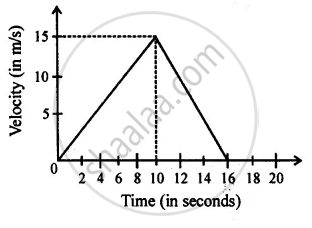
Can you use the relation [B1]?
Interpret the following graph: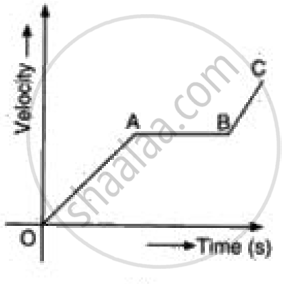
A body has an acceleration of -3.5 ms-2. What is its retardation?
When an object undergoes acceleration ______.
The value of acceleration for a body at rest is ______.
