Advertisements
Advertisements
Question
What do you mean by constant acceleration?
Advertisements
Solution
A body is said to have constant acceleration, if it travels is a straight line and its velocity increases or decreases by equal magnitude in equal intervals of time.
Ex: the motion of a freely falling body.
APPEARS IN
RELATED QUESTIONS
Give a scientific reason.
When an object falls freely to the ground, its acceleration is uniform.
An object of mass 16 kg is moving with an acceleration of 3 m/s2. Calculate the applied force. If the same force is applied to an object of mass 24 kg, how much will be the acceleration?
What is meant by the term retardation? Name its S.I. unit.
Give one example of the following motion:
Uniform retardation
A toy car initially moving with uniform velocity of 18 km h-1 comes to a stop in 2 s. Find the retardation of the car in S.I. units.
When is the acceleration due to gravity negative?
The change in velocity of a motorbike is 54 kmh−1 in one minute. Calculate its acceleration in (a) ms−2 (b) kmh−2.
A racing car is moving with a velocity of 50 m/s. On
applying brakes, it is uniformly retarded and comes to rest in 20 seconds. Calculate its acceleration.
A truck running at 90 kmh−1, is brought to rest over a distance of 25 m. Calculate the retardation and time for which brakes are applied.
A motor bike running at 5 ms−1, picks up a velocity of 30 ms−1 in 5s. Calculate
- acceleration
- distance covered during acceleration.
A car traveling at 60 km/h, stops on applying brakes in 10 seconds. What is its acceleration?
Out of energy and acceleration, which one is a vector?
State if the following situation is possible:
A body moving horizontally with an acceleration in vertical direction.
A car accelerates to a velocity of 30 m/s in 10 s and then decelerates for 20 s so that it stops. Draw a velocity-time graph to represent the motion and find:
The Deceleration.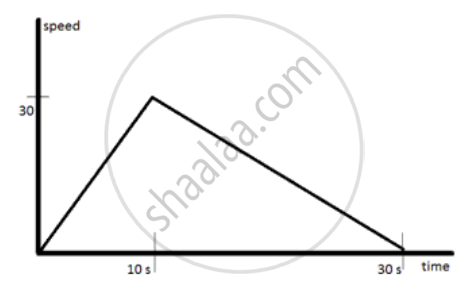
From the given v-t graph it can be inferred that an object is

A bus can accelerate with an acceleration of 1 m/s2 . Find the minimum time for the bus to attain the speed of 100 km/s from 50 km /s.
Assertion: The accelerated motion of an object may be due to change in magnitude of velocity or direction or both of them.
Reason: Acceleration can be produced only by change in magnitude of the velocity. It does not depend the direction.
The acceleration of the body that moves with a uniform velocity will be ______.
A car is being driven at a speed of 20ms-1 when brakes are applied to bring it to rest in 5 s. The deceleration produced in this case will be ______.
