Advertisements
Advertisements
Question
From the given v-t graph it can be inferred that an object is

Options
in uniform motion
at rest
in non - uniform motion
moving with uniform accelerations
Advertisements
Solution
moving with uniform accelerations
APPEARS IN
RELATED QUESTIONS
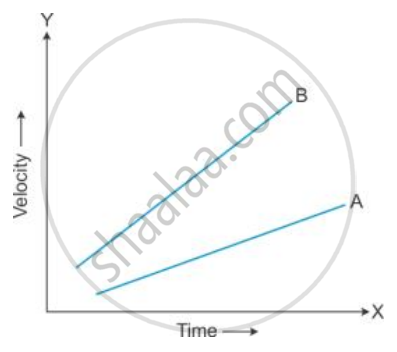
Figure shows the velocity-time graphs for two cars A and B moving in the same direction. Which car has greater acceleration? Give reasons to your answer.
A body falls freely from a certain height. Show graphically the relation between the distance fallen and square of time. How will you determine g from this graph?
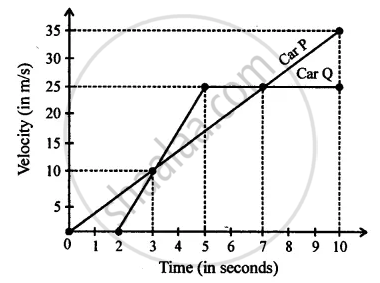
Diagram is given below shows velocity – time graph of car P and Q, starting from the same place and in the same direction. Calculate the Acceleration of car P.
A cyclist driving at 36 kmh−1 stops his motion in 2 s, by the application of brakes. Calculate
- retardation
- distance covered during the application of brakes.
The acceleration of a moving body is constant in magnitude and direction. Must the path of the body be a straight line?
If not, given an example.
The distance covered by a body is directly proportional to the square of the time elapsed. What can you say about its acceleration?
Is it possible for an accelerating body to have constant speed?
What happens to the stepwise increasing speed-time graph when the size of each step is made very small?
A body has an acceleration of -3.5 ms-2. What is its retardation?
The graph shows how the velocity of a scooter varies with time in 50 s.
Work out: Acceleration.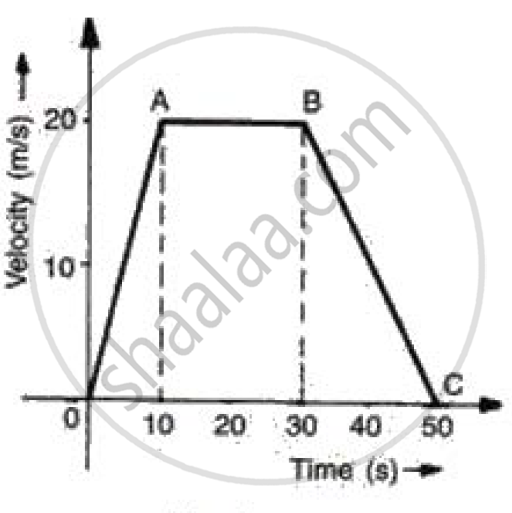
A car accelerates to a velocity of 30 m/s in 10 s and then decelerates for 20 s so that it stops. Draw a velocity-time graph to represent the motion and find:
The acceleration.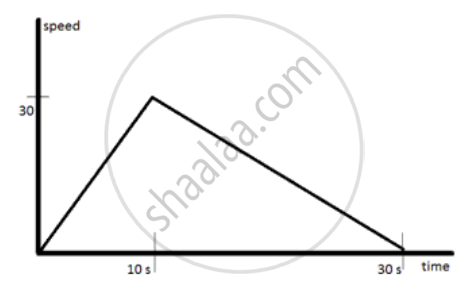
A car accelerates to a velocity of 30 m/s in 10 s and then decelerates for 20 s so that it stops. Draw a velocity-time graph to represent the motion and find:
Distance travelled
What do you mean by constant acceleration?
Negative acceleration is called ______.
Exercise Problem.
A racing car has a uniform acceleration of 4 ms–2. What distance it covers in 10 s after the start?
The acceleration of the body that moves with a uniform velocity will be ______.
Acceleration is defined as the rate of change of ______.
Assertion: A negative acceleration of a body can be associated with speeding up of the body.
Reason: Increase in the speed of a moving body is independent of its direction of motion.
Assertion: When a body is subjected to a uniform acceleration, it is always moving in a straight line.
Reason: Motion may be straight-line motion or circular motion.
