Advertisements
Advertisements
प्रश्न
From the given v-t graph it can be inferred that an object is

पर्याय
in uniform motion
at rest
in non - uniform motion
moving with uniform accelerations
Advertisements
उत्तर
moving with uniform accelerations
APPEARS IN
संबंधित प्रश्न
Give a scientific reason.
When an object falls freely to the ground, its acceleration is uniform.
An object of mass 16 kg is moving with an acceleration of 3 m/s2. Calculate the applied force. If the same force is applied to an object of mass 24 kg, how much will be the acceleration?
Define acceleration. State its unit.
State the type of motion represented by the following sketches in Figures.
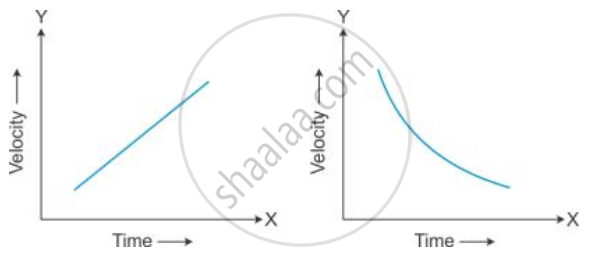
Give an example of each type of motion.
Figure shows the velocity-time graphs for two cars A and B moving in the same direction. Which car has greater acceleration? Give reasons to your answer.
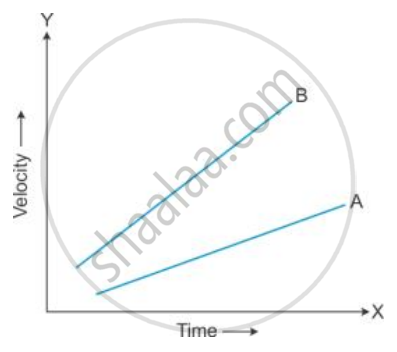
A space craft flying in a straight course with velocity of 75 km s-1 fires its rocket motors for 6.0 s. At the end of this time its speed is 120 km s-1 in the same direction.
Find
(i) The space craft's average acceleration while the motors were firing
(ii) The distance travelled by the space craft in the first 10 s after the rocket motors were started, the motors being in action for only 6 s.
A car travels with uniform velocity of 25 m s-1 for 5 s. The brakes are then applied and the car is uniformly retarded and comes to rest in further 10 s. Find:
- The distance which the car travels before the brakes are applied,
- Retardation and
- The distance travelled by car after applying the brakes.
A ball is rolling from A to D on a flat and smooth surface. Its speed is 2 cm/s. On reaching B, it was pushed continuously up to C. On reaching D from C, its speed had become 4 cm/s. It took 2 seconds for it to go from B to C. What is the acceleration of the ball as it goes from B to C?

When is the acceleration due to gravity positive?
When is the acceleration due to gravity negative?
The change in velocity of a motorbike is 54 kmh−1 in one minute. Calculate its acceleration in (a) ms−2 (b) kmh−2.
A racing car, initially at rest, picks up a velocity of 180 kmh−1 in 4.5 s. Calculate
- acceleration
- distance covered by the car.
Out of energy and acceleration, which one is a vector?
Convert the following acceleration:
1/36 m/s2 into km/h2
A car accelerates to a velocity of 30 m/s in 10 s and then decelerates for 20 s so that it stops. Draw a velocity-time graph to represent the motion and find:
Distance travelled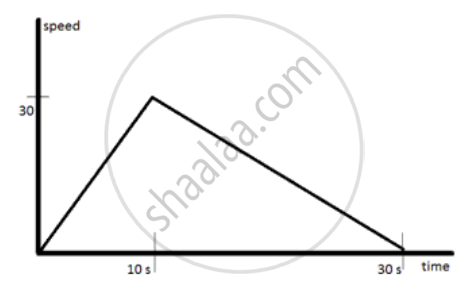
The rate of change of velocity is ______.
State whether true or false. If false, correct the statement.
Acceleration can get negative value also.
A car is being driven at a speed of 20ms-1 when brakes are applied to bring it to rest in 5 s. The deceleration produced in this case will be ______.
